
AEO & AI Search Optimisation for Greater AI Visibility
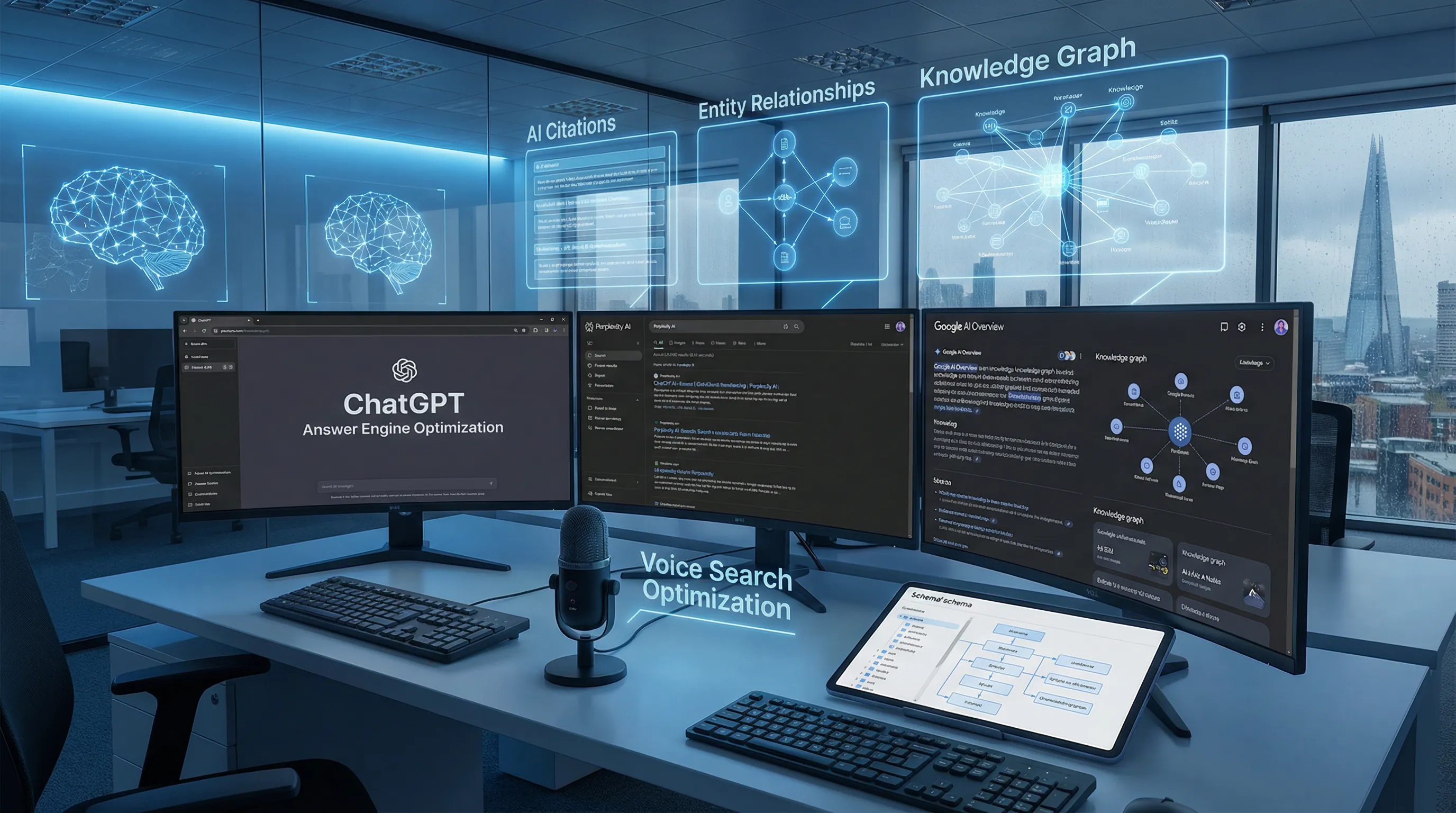
Our AEO service helps future-proof visibility by making your brand more likely to appear in AI-generated answers from ChatGPT, Perplexity, and Google AI Overviews.
Proven Results
Results are based on selected client campaigns and may vary. See case studies.
These headline figures reflect results from selected client campaigns, not guarantees or averages across every client. AI Citation Rate is the share of a defined, tracked prompt set where a client's brand appeared or was cited across the AI platforms monitored during a campaign; Featured Snippets compares snippet visibility before and after within a campaign; Voice Search Wins refers to tracked conversational queries where a client's content was surfaced as the featured or spoken answer in testing. "Number-one AEO agency" describes our specialism and positioning, not a verified ranking for a specific search query. Results vary by market, competition and platform. For a worked example, our Manchester aesthetics case study documents a clinic moving from zero to eighteen tracked AI citations alongside organic growth.
What Is Answer Engine Optimisation?
Answer Engine Optimisation, or AEO, improves a brand's visibility across AI-generated search experiences by strengthening technical accessibility, entity clarity, expert content, source authority and citation coverage. It complements traditional SEO by helping search engines and AI systems recognise when a business is a relevant and trustworthy source.
How SEO, AEO and GEO Work Together
AEO does not replace traditional SEO. It builds on it. Visibility in AI-generated search often depends on many of the same foundations that support strong organic search performance. In practice, durable AI visibility relies on:
- Pages that search engines can crawl and index
- Strong technical SEO and fast, accessible pages
- Clear, consistent entity information about your business
- Original, expert-led content that directly answers real customer questions
- Relevant internal linking that shows topical depth
- Reliable third-party references and mentions
- Structured information that machines can interpret
- Ongoing measurement across both search engines and AI platforms
No single tactic (not schema markup, not backlinks, not an FAQ block) guarantees a citation on its own; each one contributes to eligibility and machine understanding. You may see this work described as AEO, GEO (Generative Engine Optimisation), LLM optimisation or AI search optimisation. These terms overlap heavily, and we use AEO as the primary term across these pages.
Why AEO & AI Search Optimisation Matters
AI-generated search is becoming another important discovery layer alongside traditional search. Visibility depends on accessible content, clear entity information, useful answers, credible expertise and supporting references. AEO improves how clearly search and AI systems can interpret and evaluate a brand, while monitoring where it appears across selected AI-generated responses. No content format, schema type or optimisation can guarantee selection or citation.
AI Visibility
Improve how often your brand is mentioned and cited when users ask AI assistants about your industry or services.
Featured Snippets
Structure important answers clearly to improve eligibility for featured snippets and AI-generated search experiences.
Entity Optimisation
Clarify the relationships between your organisation, people, services and locations across your website and trusted external sources.
Track AI Mentions
Monitor when and how AI engines mention your brand with our AI Visibility Tool.
What's Included
A clear scope of work, tailored to your package. Each element exists to make your brand easier for AI systems to find, understand and trust.
Who AEO Suits Best
- Local service businesses
- Multi-location brands
- Medical and aesthetics businesses
- Professional-services firms
- E-commerce brands
- B2B companies
- Publishers with expert-led content
- Businesses already investing in SEO
- Organisations with complex services or high-consideration customer journeys
When AEO may not be the right fit
- •Websites that cannot be crawled or indexed properly
- •Businesses without the capacity to implement recommendations
- •Brands expecting guaranteed AI citations
- •Sites relying on thin, unverified or mass-generated content

Our AEO Process
Five stages covering baseline measurement, strategy, implementation and continuous optimisation.
AI visibility and technical baseline
We measure your current AI and organic visibility and confirm your site can be crawled and understood.
Prompt, query and competitor analysis
We research the commercial prompts that matter and analyse which sources AI currently cites.
Entity, content and authority strategy
We plan the entity, content and authority work that makes your brand a credible answer.
Technical and editorial implementation
We implement structured data, content restructuring, expert content and internal linking.
Citation monitoring and continuous optimisation
We monitor AI citations and refine the strategy every month.
Why Choose iDigitGroup?
We're not just another SEO agency. We're organic growth specialists who understand your industry and deliver measurable results.
- Pioneers in Answer Engine Optimisation (AEO)
- Proprietary AI Visibility monitoring tool
- Deep understanding of how LLMs source information
- Schema markup expertise for AI comprehension
- Content strategies designed for AI citation
Results are based on selected client campaigns and may vary. See case studies.
Success Stories
See how we've helped businesses like yours achieve remarkable results.
Professional AEO vs Doing It In-House
Much of this work can be done internally. The difference is expertise, implementation capacity, repeatable measurement and strategic prioritisation: not a claim that you cannot do any AEO yourself.
| Feature | DIY Approach | iDigitGroup |
|---|---|---|
| Initial AI visibility baseline | Ad hoc, if measured at all | Structured baseline across a defined prompt set |
| Prompt and conversational-query research | Guesswork | Researched prompts mapped to commercial intent |
| Competitor citation analysis | Rarely done | Systematic review of who AI cites, and why |
| Entity and source assessment | Inconsistent | Reviewed for clarity and consistency across the web |
| Technical implementation | Limited time and tooling | Accessibility, rendering and structured-data work |
| Expert-content development | Hard to resource | Briefed and reviewed by subject expertise |
| External mention and authority analysis | Occasional | Realistic opportunities identified and prioritised |
| Platform-specific tracking | One manual check | Monitored across selected AI platforms |
| Reporting across a defined prompt set | None | Clear trends against your own baseline |
| Ongoing testing as AI outputs change | One-off | Continuous testing and re-prioritisation |
How Our AEO and AI Search Strategy Works
AEO is a service, not a single tactic. Here is how the service is delivered to make a brand more likely to be surfaced and cited by AI answer engines:
Want the underlying theory rather than our service? Read our complete guide to Answer Engine Optimisation for the concepts behind this work.
How We Measure AEO Performance
We report on the signals that genuinely indicate AI visibility, rather than a single headline number. Depending on your market, that includes:
AI answers are not deterministic: they vary by platform, location, personalisation and time, so no tool can track every AI interaction perfectly. We measure trends across a defined prompt set rather than claiming total coverage.
For a worked example, our Manchester aesthetics case study documents a clinic moving from zero to eighteen tracked AI citations alongside organic growth.
Key Concepts in AEO and AI Search Optimisation
Answer Engine Optimisation (AEO) is a rapidly evolving discipline. These definitions will help you understand how AI-powered search engines source and present information: and how to position your brand as the authoritative answer.
- Answer Engine Optimisation (AEO)
- Answer Engine Optimisation is the process of improving technical accessibility, content clarity, entity information, source authority and measurement so a brand has a stronger chance of appearing or being cited in AI-generated search experiences. It overlaps with traditional SEO and does not guarantee selection for any query.
- Large Language Model (LLM)
- An AI system trained on large amounts of text to generate human-like responses. LLM-based search experiences can draw on the model's own knowledge, retrieval systems, indexed web content and cited external sources, depending on the platform and the query. Different platforms use different ranking and citation methods, so there is no single formula that applies to all of them.
- Entity Optimisation
- The process of making the key entities associated with a brand (people, places, organisations and services) clear and consistent. Consistent names, relationships, profiles, authorship, services and external references can help search and AI systems interpret an organisation more clearly, but do not guarantee a Knowledge Graph entry or a citation.
- Structured Data / Schema Markup
- Structured data is machine-readable markup that describes visible page content. It can help search systems interpret entities and can support eligibility for specific search features, but no special schema is required for Google's AI features and structured data does not guarantee an AI citation.
- AI Overview (formerly SGE)
- Google AI Overviews are generated search responses that may draw on multiple web sources. Pages must be eligible to appear in Google Search, but there is no separate AI Overview schema or guaranteed inclusion method. Technical accessibility, useful original content, clear page structure, relevant internal links and accurate structured data remain part of the wider SEO foundation.
Related Services
Explore complementary services that strengthen your growth strategy.
SEO Services
Full-funnel SEO programs that connect keyword demand to content, authority, and measurable business outcomes.
AI Digital Marketing
Custom AI-powered marketing systems: predictive analytics, hyper-personalisation, and automated campaigns that deliver measurable ROI.
Technical SEO
Speed, crawl, and indexing improvements that remove friction and give every page a stronger chance to rank.
Web Design & Development
Conversion-first design with SEO-ready structure, built to load fast, rank well, and guide visitors to action.
Website Maintenance
Security, uptime, and performance monitoring so your site stays fast, safe, and conversion-ready all year.
Industries We Support
See how this service delivers results in regulated and competitive sectors.
Aesthetic Clinics
Dominate local searches for aesthetic treatments
Dental Practices
Attract more patients to your dental practice
Wellness Centres
Grow your wellness business online
Hospitality
Fill more rooms and tables with organic search
Estate Agents
Attract more buyers and sellers to your agency
Legal Services
Get more high-value clients for your law firm

Every AEO engagement is overseen by Valentino, who has 15+ years in organic search, technical SEO and Answer Engine Optimisation. He reviews the methodology, the tracked prompt set and the reporting for accuracy and commercial relevance before it reaches you.
Read Valentino's profileAEO & AI Search FAQs
Answers about AI visibility, schema, and citations.
Traditional SEO improves crawlability, indexation, relevance, authority and organic search performance. AEO builds on that foundation and adds emphasis on direct answers, entity clarity, expert attribution, coverage across the sources AI systems cite, and monitoring how your brand appears across AI-generated responses. It is broader than simply being cited. It is about being an accessible, clear and credible source that both search engines and AI systems can interpret.
We research and monitor a selected set of prompts across platforms including Google AI Overviews, ChatGPT, Perplexity and Claude where appropriate. Each platform behaves differently and can use different sources and methods, so there is no universal ranking formula and no single optimisation that controls all of them. We focus on the shared fundamentals (accessibility, clarity, entities and authority) and measure per platform.
Yes, where it accurately represents the visible content of a page. Relevant schema can help search systems interpret entities and support eligibility for certain features, but no special schema guarantees AI visibility, and adding FAQPage, Service or Article markup does not by itself cause an AI system to cite a page. We treat structured data as one supporting element of a healthy technical foundation, not a shortcut.
We work across several areas together: technical accessibility, useful expert-led content, direct answers to real questions, consistent entity information, internal linking, relevant external references, and source authority: supported by ongoing citation monitoring. Together these improve your eligibility and visibility across AI-generated search, but they cannot guarantee citations, because AI systems ultimately control what they reference.
No. AEO builds on traditional SEO rather than replacing it. AI systems still rely on content they can crawl, index and trust, so technical SEO, clear entities and authoritative content remain essential. We treat AEO as an extension of a healthy SEO foundation, not a substitute for it.
They overlap heavily. AEO (Answer Engine Optimisation) is the broad term for being cited by AI answers; GEO (Generative Engine Optimisation) and LLM optimisation describe the same goal from the generative-model angle. We use AEO as the primary term and focus on the shared fundamentals (clarity, structure and authority) rather than the labels.
It varies by market, competition and your starting authority. Technical and structured-data fixes can be implemented quickly, while citation and entity gains typically build over several months as content and authority signals mature. We set a baseline first, so progress is measured against your own starting point rather than a generic promise.
We use our AI Visibility Tool alongside manual checks to monitor how often your brand appears across a defined set of prompts on platforms such as ChatGPT, Perplexity and Google AI Overviews. Because AI answers vary by platform, location and time, we report trends across that prompt set rather than a single fixed figure.
No, and we would be wary of anyone who does. AI systems decide what to cite using signals we can strengthen (clarity, structure, authority and relevance) but no agency controls their output. We focus on improving your eligibility and measuring the trend, not on promising guaranteed placements.
Yes, where your package and platform allow it. We can implement structured data, content changes, internal linking and technical fixes ourselves, or provide briefs for your team. We typically need access to your website or CMS, Search Console and analytics, and your Google Business Profile where local visibility matters: all confirmed at kick-off.
AEO is included from our Growth plan, which starts at £997 per month, and is expanded further in our Dominate plan. Our entry-level Essential plan (£597 per month) focuses on core SEO and website care and does not include the AEO service described here. The right tier depends on your market, competition and how much content and implementation is involved. You can compare exactly what each plan includes on our pricing page.
Yes. Local businesses increasingly appear, or fail to appear, when people ask AI tools for recommendations nearby, so consistent local signals and clear entities help. For regulated sectors like healthcare and aesthetics it often matters most: we work within advertising and sector rules, avoid unsupported claims, and rely on expert-led, reviewed content.
Related Resources
Explore practical guides to AEO, AI citations, entity optimisation and the changing relationship between SEO and AI search.