
Introduction: Will AI Replace SEO?
Answer Engine Optimisation is the practice of structuring content so that AI-powered search systems (Google AI Overviews, ChatGPT, Perplexity, Bing Copilot) cite it as a source when answering user questions. Being cited in an AI answer is worth more than a traditional organic ranking for many query types, because the AI's answer IS the result: there's no click required to establish authority, and the citation that does appear carries disproportionate credibility. This guide covers how these systems decide what to cite, what content structures earn citations, and how to measure whether your AEO efforts are working.
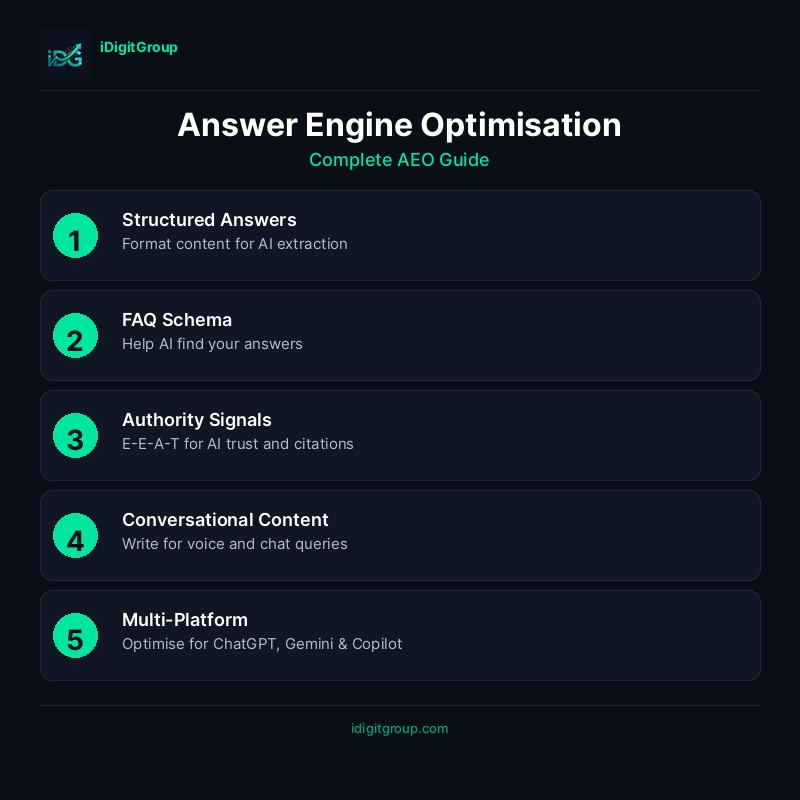
While traditional SEO focuses on ranking in search results, AEO focuses on being the source AI cites when answering questions.
"By 2026, 30% of all search queries will be answered by AI without users clicking through to websites. Being the cited source is the new ranking #1."
Understanding How AI Search Works
How AI is Changing Search
AI search engines process queries fundamentally differently from traditional search. Instead of matching keywords to web pages, AI systems understand the intent behind a query, synthesise information from multiple sources, and generate a comprehensive answer. This means that ranking first for a keyword is no longer sufficient: your content needs to be the authoritative source that AI systems trust and cite. The shift from keyword-matching to intent-understanding rewards businesses that create genuinely helpful, comprehensive content over those that simply optimise for specific search terms.
| Step | What Happens | Your Opportunity |
|---|---|---|
| 1. Query understanding | AI interprets user intent | Match intent precisely |
| 2. Source retrieval | AI finds relevant content | Be findable, authoritative |
| 3. Information extraction | AI pulls key information | Structure content clearly |
| 4. Answer synthesis | AI combines sources | Be comprehensive |
| 5. Citation | AI attributes sources | Build citation-worthy authority |
What AI Looks For in Sources
AI search engines evaluate content differently from traditional search algorithms. They prioritise content that provides clear, authoritative, and well-structured answers to specific questions. Content with strong E-E-A-T signals (Experience, Expertise, Authoritativeness, Trustworthiness) is more likely to be cited. AI systems also favour content that uses natural language, includes relevant data and statistics, and is structured with clear headings and concise paragraphs. Websites with strong domain authority and a history of accurate, up-to-date content are cited more frequently than newer or less established sources.
| Factor | Importance | How to Optimise |
|---|---|---|
| Authority | Very High | E-E-A-T signals, credentials |
| Relevance | Very High | Topic focus, keyword alignment |
| Clarity | High | Clear structure, direct answers |
| Freshness | High | Regular updates, current data |
| Accuracy | Critical | Fact-checking, citations |
AEO vs Traditional SEO
Key Differences
| Aspect | Traditional SEO | AEO |
|---|---|---|
| Goal | Rank in SERPs | Be cited by AI |
| Success metric | Position, clicks | Citations, mentions |
| Content format | Varied | Q&A, structured |
| Keyword focus | Search terms | Questions, entities |
Core AEO Strategies
Strategy 1: Question-Answer Content Structure
Format content to directly answer questions:
| Element | Implementation | Example |
|---|---|---|
| Question heading | H2 or H3 with question | "How long does Botox last?" |
| Direct answer | First sentence answers | "Botox typically lasts 3-4 months..." |
| Supporting detail | Expand with context | Factors affecting duration |
Strategy 2: Comprehensive Topic Coverage
AI prefers comprehensive sources:
| Coverage Level | Content Approach | Citation Likelihood |
|---|---|---|
| Surface | Basic overview | Low |
| Moderate | Main points covered | Medium |
| Comprehensive | All aspects addressed | High |
| Authoritative | Unique insights, data | Very High |
Strategy 3: Structured Data Implementation
Help AI understand your content:
| Schema Type | Use Case | AEO Benefit |
|---|---|---|
| FAQPage | Q&A content | Direct answer extraction |
| HowTo | Process content | Step-by-step citation |
| Article | Blog posts | Author/source attribution |
Strategy 4: E-E-A-T Enhancement
Build signals AI trusts:
| E-E-A-T Element | How to Demonstrate |
|---|---|
| Experience | First-hand accounts, case studies |
| Expertise | Credentials, qualifications, depth |
| Authoritativeness | Citations, mentions, links |
| Trustworthiness | Accuracy, transparency, reviews |
Optimising for Specific AI Platforms
Google AI Overviews
| Factor | Optimisation |
|---|---|
| Featured snippets | Optimise for snippet capture |
| People Also Ask | Answer related questions |
| Schema markup | Comprehensive implementation |
ChatGPT and GPT-Based Tools
| Factor | Optimisation |
|---|---|
| Training data inclusion | Publish before training cutoffs |
| Web browsing mode | Current, authoritative content |
| Clear attribution | Make authorship obvious |
Measuring AEO Success
Key Metrics
| Metric | How to Track | Target |
|---|---|---|
| AI citations | Manual monitoring, tools | Increasing trend |
| Featured snippets | Search Console, rank trackers | Key terms captured |
| Brand mentions | Brand monitoring tools | Growing mentions |
AEO Content Templates
FAQ Page Template
Structure your FAQ pages with clear questions as headings and direct answers in the first sentence, followed by supporting detail.
How-To Content Template
Start with a summary answer, then provide step-by-step instructions with clear headings for each step.
Common AEO Mistakes
| Mistake | Problem | Solution |
|---|---|---|
| Thin content | Not comprehensive enough | Expand to cover all aspects |
| No structure | AI can't extract answers | Use clear headings, Q&A format |
| Missing schema | AI misunderstands content | Implement relevant schema |
| Outdated info | AI prefers current sources | Regular content updates |
Frequently Asked Questions
Is AEO replacing SEO?
No. AEO complements SEO. Strong SEO builds the authority that makes AEO effective.How quickly can I see AEO results?
AEO results vary by platform. Google AI Overviews can reflect changes within weeks.Should small businesses focus on AEO?
Yes, especially for local and niche topics where you can establish authority.Conclusion: The Future is Answer-First
AEO represents the next evolution in search optimisation. By creating content that AI can easily understand, extract, and cite, you position your business for visibility in an AI-first search landscape.
Ready to optimise for AI search? Our AEO specialists can help you adapt your content strategy. Contact us for an AEO audit.
---
Related Reading
Related Services
- AEO & AI Search Optimisation - Dominate AI search results
- SEO Services - Full-service organic growth
- Technical SEO - Technical foundation