
Technical SEO Services for Better Crawling, Indexing and Performance
Our Technical SEO audits identify and resolve issues affecting crawling, rendering, indexation, site architecture and performance, giving important pages a stronger foundation for organic search visibility.
Proven Results
Results are based on selected client campaigns and may vary. See case studies.
These headline figures reflect results from selected client projects, not guarantees or averages across every site. Speed improvement compares a page's load performance before and after optimisation within a project; PageSpeed scores are laboratory measurements for a specific page and device that can vary between runs; "crawl efficiency" here means important URLs made accessible and wasted or error crawl requests reduced against a defined starting set; and "zero critical errors" describes the point-in-time result of a specific audit scope, not a permanent state: any live site can develop new issues over time. For a worked example, our Calcolalo platform case study documents 150+ pages indexed from launch through an SEO-first architecture.
What Is Technical SEO?
Technical SEO improves how search engines discover, render, crawl, interpret and index a website. It covers areas such as site architecture, internal linking, crawl directives, canonicalisation, JavaScript rendering, structured data, performance and migrations. Technical improvements remove barriers to organic visibility, but they do not guarantee that every page will be crawled, indexed or ranked.
Core Web Vitals
Improve loading performance, responsiveness and visual stability to support user experience and wider page-experience quality.
Crawlability
Remove unnecessary barriers that prevent search engines from discovering and accessing important URLs, while checking that indexation directives reflect the intended strategy.
Site Speed
Identify performance bottlenecks affecting real users and search accessibility, then prioritise the improvements with the strongest practical impact.
Security & HTTPS
Check HTTPS implementation, mixed content, redirects, certificate coverage and security-related technical issues that affect users and site integrity.
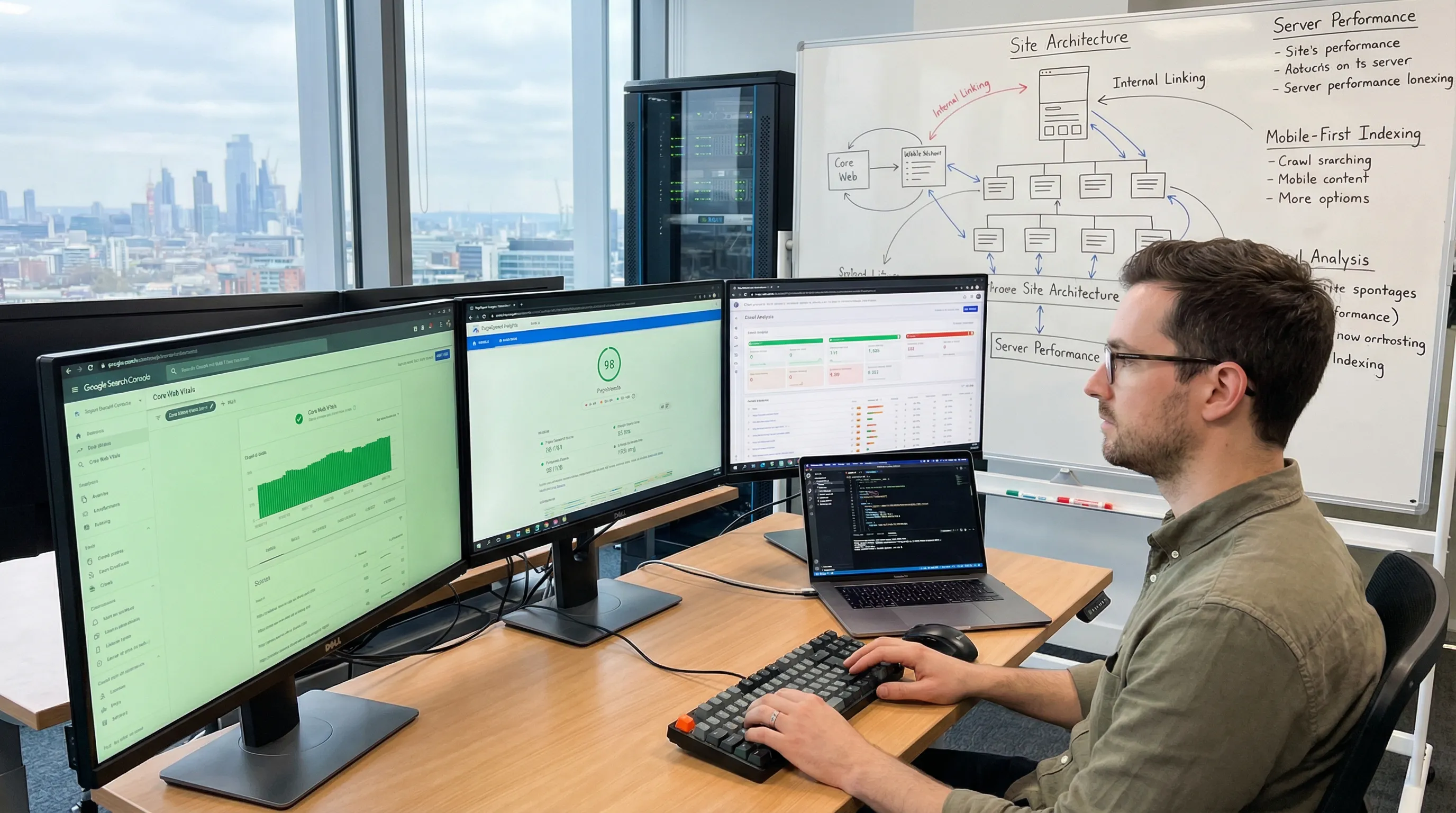
What's Included
A prioritised Technical SEO programme covering crawling, indexation, architecture, performance, structured data and implementation support.
Perfect For
- Large websites
- E-commerce stores
- Sites with ranking drops
- New website launches
- Site migrations
- Any site with technical debt

Our Process
A four-step Technical SEO workflow, from a crawl-and-indexation baseline through to monitoring and regression prevention.
Crawl and Indexation Baseline
We review Search Console, crawl data, important templates, indexation states, sitemap coverage, robots directives, canonicals, redirects and rendering behaviour, using server logs where available and appropriate.
Diagnosis and Prioritisation
We group issues by root cause, affected templates, organic impact, implementation risk, development dependency and business priority: not an unprioritised list of tool warnings.
Implementation and Quality Assurance
We implement or coordinate approved fixes, then validate them in staging and production across important templates, devices and search directives. Depending on your package, we implement directly or provide developer-ready tickets.
Monitoring and Regression Prevention
We monitor indexation, crawling, performance, structured-data errors, redirects and releases so critical issues are caught after implementation or future site changes.
Why Choose iDigitGroup?
We're not just another SEO agency. We're organic growth specialists who understand your industry and deliver measurable results.
- Certified technical SEO specialists
- Experience with all major CMS platforms
- Advanced crawl analysis tools
- Core Web Vitals optimisation expertise
- Schema markup implementation
Results are based on selected client campaigns and may vary. See case studies.
Success Stories
See how we've helped businesses like yours achieve remarkable results.
Professional Technical SEO vs Doing It In-House
Internal teams can carry out Technical SEO. Professional support mainly adds specialist diagnosis, implementation capacity, prioritisation and quality assurance.
| Feature | DIY Approach | iDigitGroup |
|---|---|---|
| Crawl and indexation diagnosis | Surface-level | Root-cause diagnosis across templates |
| Search Console and analytics interpretation | Reports read in isolation | Interpreted against templates and impact |
| Canonical and redirect review | Often missed | Systematic review and correction |
| JavaScript rendering checks | Rarely tested | Rendered-DOM and crawler checks |
| Core Web Vitals diagnosis | Score-chasing | Field-data diagnosis of real bottlenecks |
| Structured-data validation | Copy-paste risk | Validated against visible content |
| Site migration safeguards | High-risk | Redirect mapping, testing and monitoring |
| Developer-ready implementation tickets | Vague requests | Clear, testable tickets |
| Staging and production QA | Often skipped | Validated before and after release |
| Regression monitoring | Reactive | Ongoing, release-aware monitoring |
| Prioritisation by impact and risk | Warning-driven | Impact- and risk-based prioritisation |
How We Prioritise Technical SEO Fixes
Not every warning from an automated audit deserves immediate implementation. We prioritise fixes with a clear framework so effort goes where it protects and improves organic visibility most.
This keeps the roadmap focused on issues that genuinely affect discovery, rendering, indexation and performance, rather than a long list of low-impact warnings.
Key Concepts in Technical SEO
Technical SEO forms the foundation on which all content and link-building efforts rest. Without a technically sound website, even the best content will underperform. These are the core concepts every business owner should understand.
- Crawlability
- The ability of search engines to discover, access, render and process a page. These are distinct stages: a URL can be discovered but not crawled, crawled but not indexed, or indexed under a different canonical. Crawlability problems (blocked resources, orphan pages or rendering issues) can prevent pages from reaching indexing, but crawlability alone does not determine whether a page is ultimately indexed.
- Core Web Vitals
- A set of metrics that measure real-world page experience: Largest Contentful Paint (LCP, loading), Interaction to Next Paint (INP, responsiveness) and Cumulative Layout Shift (CLS, visual stability). They are used within Google's broader ranking systems as part of page experience, but passing the thresholds does not guarantee higher rankings: content relevance and quality remain the primary factors.
- Canonical Tag
- An HTML signal (rel="canonical") that indicates the preferred, representative URL among duplicate or highly similar pages, helping consolidate signals. It is a hint rather than a directive: Google may select a different canonical when other signals conflict. Ordinary duplication is a normal part of the web and is not, in itself, a penalty.
- Structured Data (JSON-LD)
- Machine-readable markup that describes a page's visible content to search engines. It may support eligibility for specific rich results, but it does not directly improve rankings, does not guarantee rich results and is not a prerequisite for appearing in Google's AI features.
- Indexing Status
- The indexing state of a site's URLs: indexed, excluded, redirected, canonicalised, blocked or in error. Search Console and crawl data help identify these states and any genuine issues. Many exclusions are intentional, so a URL marked noindex or excluded is not necessarily a problem to fix.
Related Services
Explore complementary services that strengthen your growth strategy.
SEO Services
Full-funnel SEO programs that connect keyword demand to content, authority, and measurable business outcomes.
Local SEO Services
Map pack, location page, and review strategies that turn nearby searches into calls, directions, and booked appointments.
AEO & AI Search
Structured content and entity signals designed to earn citations across ChatGPT, Perplexity, and Google AI Overviews.
Web Design & Development
Conversion-first design with SEO-ready structure, built to load fast, rank well, and guide visitors to action.
Website Maintenance
Security, uptime, and performance monitoring so your site stays fast, safe, and conversion-ready all year.
Industries We Support
See how this service delivers results in regulated and competitive sectors.
Aesthetic Clinics
Dominate local searches for aesthetic treatments
Dental Practices
Attract more patients to your dental practice
Wellness Centres
Grow your wellness business online
Hospitality
Fill more rooms and tables with organic search
Estate Agents
Attract more buyers and sellers to your agency
Legal Services
Get more high-value clients for your law firm
Technical SEO FAQs
Key questions about technical audits and fixes.
We diagnose and resolve issues across crawling, indexation, site architecture, canonicalisation, redirects and status codes, JavaScript rendering, structured data, mobile rendering and Core Web Vitals: prioritised by impact and risk rather than a raw list of tool warnings.
Crawlability is whether a search engine can discover and access a URL; indexability is whether, once crawled and rendered, the page is eligible to be stored in the index. A page can be crawlable but not indexed: for example, marked noindex or treated as a duplicate under another canonical. Discovery, crawling, rendering and indexing are separate stages.
Yes. We review LCP, INP and CLS using field and lab data, diagnose the underlying causes and give you a prioritised plan. Core Web Vitals are part of Google's page-experience signals, so improving them supports user experience rather than guaranteeing higher rankings.
It depends on your package. On some plans we implement approved fixes directly; on others we provide developer-ready tickets for your team or work alongside your developers. We confirm which applies before we begin.
No. Technical SEO removes barriers to crawling, rendering, indexation and performance, giving your important pages a stronger foundation. Rankings also depend on content, relevance, competition and authority, so no agency can guarantee ranking improvements from technical work alone.
We plan the migration, map redirects, test in staging and monitor indexation and performance closely after launch, so issues are caught early. Careful planning, redirect mapping, testing and monitoring substantially reduce migration risk, but no agency can guarantee zero ranking fluctuation or traffic loss.
Typically read access to Google Search Console and analytics, the ability to crawl the site, and, where relevant, access to your CMS or codebase and a staging environment. Server log access helps but is optional. We confirm exactly what's needed at kick-off.
The cadence depends on your plan and scope. Higher-tier plans include scheduled quarterly reviews, and all engagements include ongoing monitoring for critical issues between audits. We confirm the exact frequency for your plan at the outset.
Technical SEO is delivered within our monthly plans, which start at £597 per month, with deeper audits, implementation and scheduled reviews in higher tiers. The right level depends on your site's size and complexity. You can compare what each plan includes on our pricing page.
Related Resources
Explore practical guides to crawling, indexation, Core Web Vitals, site migrations and structured data.