
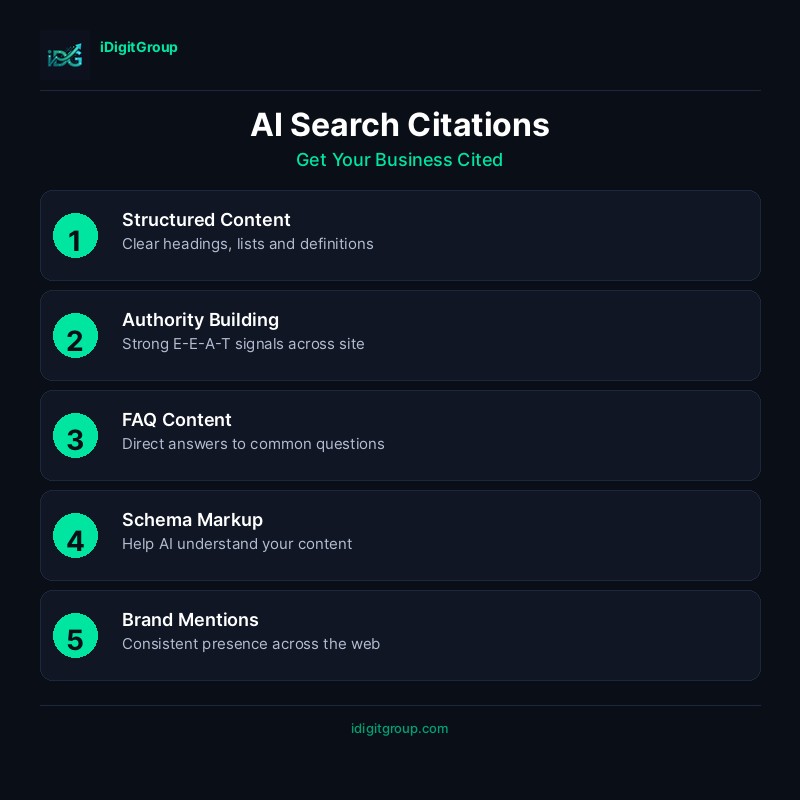
Generative Engine Optimisation (GEO) is the new frontier of digital marketing. While traditional SEO focuses on ranking in a list of blue links, GEO is about getting your brand, products, and services directly cited and recommended within AI-generated answers from platforms like Google AI Overviews, ChatGPT, and Perplexity. With over 800 million weekly users on ChatGPT alone and AI Overviews appearing in over 16% of Google searches, mastering GEO is no longer optional, it's essential for survival and growth in 2026.
This guide provides a comprehensive framework for understanding and implementing GEO, ensuring your business doesn't just rank, but gets recommended.
What is Generative Engine Optimisation (GEO)?
Generative Engine Optimisation (GEO) is the practice of optimising your content to be discovered, understood, and cited by AI-powered search engines such as Google's AI Overviews, ChatGPT, Perplexity, and Claude. Unlike traditional SEO, which focuses on ranking blue links, GEO aims to position your content as a trusted source that AI systems reference when generating answers. As AI search adoption accelerates, with over 40% of search queries now triggering AI-generated responses, businesses that fail to optimise for GEO risk becoming invisible in the new search landscape.
Key Differences: SEO vs. GEO
While traditional SEO and GEO share foundational principles, they differ in important ways. SEO optimises for keyword matching and link authority to rank web pages. GEO optimises for entity recognition, content extractability, and source authority to be cited in AI-generated answers. In SEO, success means appearing on page one. In GEO, success means being the source that AI references when answering a user's question. The most effective strategy combines both approaches, ensuring your content ranks well in traditional search while also being structured for AI citation.
GEO is the strategic process of making your content and brand easily discoverable, understandable, and citable for AI language models. Unlike SEO, where the goal is to earn a click, the primary goal of GEO is to earn a mention within the AI's response. This requires a shift in mindset from optimising for keywords to optimising for answers.
Key Differences: SEO vs. GEO
| Feature | Traditional SEO | Generative Engine Optimisation (GEO) |
|---|---|---|
| Primary Goal | Rank in top search positions | Be cited or mentioned in AI answers |
| Success Metrics | Rankings, clicks, organic traffic | Citations, mentions, share of voice, sentiment |
| User Interaction | User clicks a link to visit your site | AI includes your brand in its direct response |
| Key Platforms | Google Search, Bing | Google AI Overviews, ChatGPT, Perplexity, Gemini |
| Content Optimisation | Keywords, title tags, meta descriptions | Self-contained facts, clear paragraphs, structured data |
| Credibility Signals | Backlinks, domain authority, E-E-A-T | Brand mentions, community validation, data accuracy |
The 5 Principles of GEO for AI Visibility
Our research into what makes brands consistently appear in AI answers reveals five core principles. These principles provide a stable foundation for your GEO strategy, even as the technology rapidly evolves.
1. SEO Fundamentals are the Foundation
GEO does not replace SEO; it builds upon it. A technically sound website, high-quality content, and a strong backlink profile are prerequisites for AI visibility. AI systems are more likely to trust and cite sources that are already considered authoritative by traditional search engines.
2. Build a Clear Knowledge Entity
AI models think in terms of entities, people, places, organisations, and concepts. Your brand must be a clear, well-defined entity that the AI can understand. This means ensuring consistency across all platforms:
- Website: Your "About Us" page, contact information, and company details must be clear and accurate.
- Knowledge Panels: A complete Google Business Profile is essential.
- Third-Party Platforms: Consistent information on Wikipedia, industry directories, and review sites reinforces your entity.
3. Optimise for Content Extractability
AI search engines need to extract clear, concise answers from your content. Structure your pages with direct, factual statements that AI can easily quote. Use definition-style formatting: start sections with a clear statement of what something is, followed by supporting details. Include statistics with sources, step-by-step instructions, and comparison tables that AI can reference directly. Avoid burying key information in long paragraphs: instead, lead with the answer and then elaborate. FAQ sections are particularly effective for GEO, as they mirror the question-answer format that AI search engines use to generate responses.
4. Build Topical Authority Through Content Depth
AI search engines prioritise sources that demonstrate comprehensive expertise on a topic. Rather than publishing shallow content across many topics, focus on building deep content clusters around your core areas of expertise. Create pillar pages supported by detailed subtopic articles, all interlinked to demonstrate your authority. The more consistently your brand appears as an authoritative source across related topics, the more likely AI systems are to cite you in their responses.
5. Leverage Structured Data and Entity Signals
Implement comprehensive schema markup to help AI systems understand your content's context and authority. Organisation schema, Author schema, and Article schema provide explicit signals about who created the content and their credentials. These structured data signals feed into knowledge graphs that AI systems use to evaluate source credibility. Ensure your brand has consistent entity information across Wikipedia, Wikidata, Google Knowledge Graph, and major industry databases.
AI engines construct answers by extracting and reassembling snippets of information from various sources. Your content must be structured for easy extraction. This involves:
- Self-Contained Paragraphs: Each paragraph should make a clear point that can be understood in isolation.
- Factual Accuracy: Provide clear, citable facts, data, and statistics.
- Structured Data: Use Schema.org markup (like
FAQPage,HowTo, andArticle) to explicitly label your content for machines.
4. Cultivate Multi-Platform Presence
AI doesn't just look at your website. It learns from the entire web. A strong GEO strategy requires a presence where your audience is asking questions and having conversations. This includes:
- Community Forums: Engaging in relevant discussions on Reddit and Quora.
- Review Sites: Encouraging detailed, positive reviews on platforms like Trustpilot and G2.
- Industry Publications: Contributing guest posts and earning mentions in authoritative journals.
5. Measure What Matters: Citations and Share of Voice
Traditional SEO metrics like traffic and rankings are insufficient for GEO. You need to track:
- AI Visibility Score: How often your brand is mentioned in AI answers for your target queries.
- Share of Voice: Your visibility compared to your competitors.
- Sentiment: Whether the mentions are positive, neutral, or negative.
Practical Steps to Implement GEO
Ready to get started? Here are actionable steps to begin optimising for generative engines.
Step 1: Conduct a GEO Audit
First, understand your current AI visibility. Use tools to track how often your brand is mentioned for key topics in Google AI Overviews, ChatGPT, and Perplexity. Identify your main competitors and benchmark your performance.
Step 2: Reinforce Your Brand Entity
- Google Business Profile: Fully complete every section of your GBP, including services, products, Q&As, and posts.
- Schema Markup: Implement
OrganizationandLocalBusinessschema on your homepage. - About Us Page: Create a comprehensive "About Us" page that details your company's history, mission, and expertise.
Step 3: Restructure Your Key Content
Review your most important service pages and blog posts. Rework the content to be highly scannable and extractable:
- Use clear, descriptive headings (H2, H3).
- Break down complex topics into simple, self-contained paragraphs.
- Incorporate bulleted lists, numbered lists, and tables.
- Add a comprehensive FAQ section to each page, marked up with
FAQPageschema.
Step 4: Expand Your Digital Footprint
Identify the top 3-5 online communities or publications where your target audience is active. Develop a strategy for consistent, valuable engagement. This is not about spamming links, but about building authority and earning natural mentions.
Frequently Asked Questions (FAQ)
Q: Is SEO dead because of GEO? A: No. SEO is the foundation of GEO. Strong SEO performance is a prerequisite for being considered a trustworthy source by AI engines. The two are complementary.
Q: How long does it take to see results from GEO? A: GEO is a long-term strategy. While some quick wins can be achieved by optimising existing content, building a strong brand entity and multi-platform presence can take 6-12 months of consistent effort.
Q: What is the most important factor for GEO? A: There is no single most important factor. Like SEO, GEO is about the holistic combination of technical soundness, content quality, and brand authority. However, content structured for extractability is a critical and often overlooked element.