
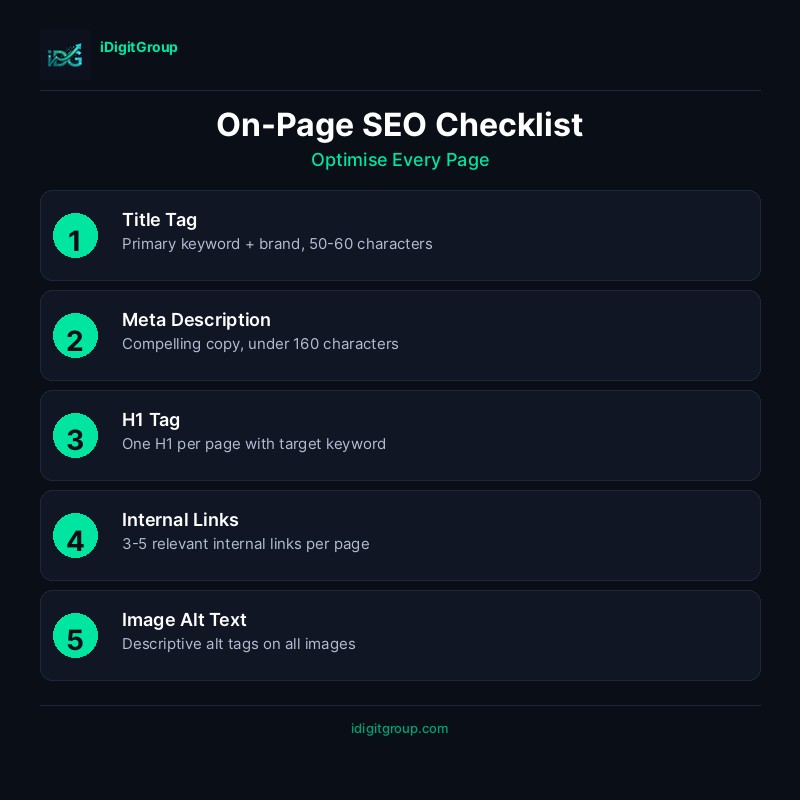
Introduction: The Foundation of Search Visibility
Get on-page SEO wrong and nothing else matters. You can earn the best backlinks in your sector and still rank below a competitor whose page sends clearer signals to Google about what it is, who it's for, and why it deserves to rank. This checklist covers every element you control directly (title tags, headings, content structure, internal linking, image optimisation) in the order that makes sense to work through them. Run through it for any page you want to rank, not just once, but whenever the page is substantially updated.
A well-optimised page has the best chance of ranking and converting. Every element on your page sends signals to search engines about what your content is about and who it's for.
"On-page SEO is about making it easy for search engines to understand what your page is about and why it deserves to rank.", Moz
This comprehensive checklist covers every on-page SEO element you need to optimise for better search engine rankings, organised by priority and impact.
The Complete On-Page SEO Checklist
Title Tag Optimisation
The title tag is one of the most important on-page ranking factors. It appears in search results and browser tabs, influencing both rankings and click-through rates.
| Element | Best Practice | Example | |
|---|---|---|---|
| Length | 50-60 characters | "SEO for Dentists: Complete Guide to Ranking Higher" | |
| Keyword Placement | Primary keyword near the beginning | "Aesthetic Clinic SEO: How to Attract More Patients" | |
| Brand | Add brand name at end (if space) | "Local SEO Guide | iDigitGroup" |
| Uniqueness | Unique for every page | Never duplicate across pages | |
| Clarity | Descriptive and compelling | Clearly describe page content | |
| Action Words | Use power words when appropriate | "Complete", "Ultimate", "Guide", "How to" |
- Keyword stuffing (repeating keywords unnaturally)
- Too long (gets truncated in search results)
- Too short (misses ranking opportunities)
- Duplicate titles across multiple pages
- Missing primary keyword entirely
Meta Description Optimisation
While not a direct ranking factor, meta descriptions significantly impact click-through rates, which can indirectly affect rankings.
Meta Description Checklist:
- ☐ Length: 150-160 characters
- ☐ Include target keyword naturally
- ☐ Include a clear call-to-action
- ☐ Unique for each page
- ☐ Accurately describes page content
- ☐ Compelling and click-worthy
- ☐ Includes value proposition
"Learn how to rank your aesthetic clinic on Google with our comprehensive SEO guide. Discover proven strategies for local SEO, content marketing, and technical optimisation. Free checklist included."
Header Structure and Hierarchy
Proper heading structure helps search engines understand your content hierarchy and improves accessibility:
| Heading | Purpose | Best Practices |
|---|---|---|
| H1 | Page title | One per page, includes primary keyword |
| H2 | Main sections | Include secondary keywords, 3-8 per page |
| H3 | Subsections | Support H2 topics, include related terms |
| H4-H6 | Further subdivisions | Use sparingly for complex content |
- One H1 per page - This is your main title
- Don't skip levels - Go H1 → H2 → H3, not H1 → H3
- Include keywords naturally - Don't force keywords into every heading
- Make headings descriptive - Users should understand the section from the heading
- Use for structure, not styling - Don't use H2 just because you want bigger text
URL Structure Optimisation
Clean, descriptive URLs help both users and search engines understand page content:
| Element | Good Practice | Bad Practice |
|---|---|---|
| Length | Short and descriptive | Long with unnecessary parameters |
| Keywords | Include target keyword | Generic or numbered URLs |
| Separators | Use hyphens (-) | Use underscores (_) or spaces |
| Case | Lowercase only | Mixed case |
| Structure | Logical hierarchy | Flat or confusing structure |
- ✅ Good:
/services/aesthetic-clinic-seo - ❌ Bad:
/page.php?id=123&cat=services - ✅ Good:
/blog/local-seo-guide - ❌ Bad:
/blog/2024/01/15/post-title-here-is-very-long
Content Optimisation
Content is the core of on-page SEO. Here's how to optimise it effectively:
Content Length Guidelines
| Page Type | Minimum Words | Optimal Words |
|---|---|---|
| Service pages | 500 | 800-1,500 |
| Blog posts | 1,200 | 1,500-2,500 |
| Landing pages | 300 | 500-1,000 |
| Product pages | 300 | 500-800 |
| Category pages | 200 | 300-500 |
Keyword Optimisation
Primary Keyword Placement:
- ☐ In the title tag
- ☐ In the H1 heading
- ☐ In the first 100 words
- ☐ In at least one H2
- ☐ In the URL
- ☐ In the meta description
- ☐ Naturally throughout content
- Include related terms and synonyms
- Use in H2 and H3 headings
- Distribute naturally throughout content
- Don't force or over-optimise
Content Quality Checklist
- ☐ Comprehensive - Covers the topic thoroughly
- ☐ Original - Not duplicated from other sources
- ☐ Accurate - Factually correct and up-to-date
- ☐ Readable - Short paragraphs, clear language
- ☐ Scannable - Headers, bullets, and white space
- ☐ Valuable - Provides genuine value to readers
- ☐ Actionable - Includes practical takeaways
Image Optimisation
Images impact both user experience and SEO. Optimise every image on your site:
| Element | Best Practice | Impact |
|---|---|---|
| File name | Descriptive, keyword-rich | Helps image search rankings |
| Alt text | Descriptive, natural language | Accessibility and image SEO |
| File size | Compressed without quality loss | Page speed |
| Format | WebP or AVIF for web | Smaller file sizes |
| Dimensions | Specify width and height | Prevents layout shift (CLS) |
| Lazy loading | Load images as needed | Faster initial page load |
- ✅ Good: "Patient receiving Botox treatment at aesthetic clinic"
- ❌ Bad: "IMG_12345.jpg"
- ❌ Bad: "Botox Botox treatment Botox clinic Botox London"
Internal Linking Strategy
Internal links distribute PageRank and help search engines understand your site structure:
Internal Linking Checklist:
- ☐ Link to relevant pages from within content
- ☐ Use descriptive anchor text (not "click here")
- ☐ Ensure important pages receive more internal links
- ☐ Create logical content clusters
- ☐ Fix broken internal links
- ☐ Avoid orphan pages (pages with no internal links)
| Type | Example | When to Use |
|---|---|---|
| Exact match | "aesthetic clinic SEO" | Sparingly |
| Partial match | "SEO services for clinics" | Regularly |
| Branded | "iDigitGroup's SEO guide" | For brand mentions |
| Generic | "learn more", "read this guide" | Occasionally |
| Natural | "we've written about this before" | When contextually appropriate |
Technical On-Page Elements
Don't overlook these technical elements that impact rankings:
Schema Markup
Implement structured data to enable rich results:
- ☐ Organization schema - Company information
- ☐ LocalBusiness schema - For local businesses
- ☐ Article schema - For blog posts
- ☐ FAQ schema - For FAQ sections
- ☐ BreadcrumbList schema - For navigation
- ☐ Service schema - For service pages
- ☐ Review schema - For testimonials
Page Speed Elements
- ☐ Minified CSS and JavaScript
- ☐ Compressed images
- ☐ Browser caching enabled
- ☐ CDN implemented
- ☐ Render-blocking resources eliminated
- ☐ Core Web Vitals passing
Mobile Optimisation
- ☐ Responsive design
- ☐ Touch-friendly buttons (minimum 48x48 pixels)
- ☐ Readable font sizes (minimum 16px)
- ☐ No horizontal scrolling
- ☐ Fast mobile loading
E-E-A-T Signals
Demonstrate Experience, Expertise, Authoritativeness, and Trustworthiness:
| Signal | Implementation |
|---|---|
| Author bios | Include credentials and expertise |
| About page | Detailed company and team information |
| Contact information | Clear, accessible contact details |
| Citations | Link to authoritative sources |
| Reviews | Display customer testimonials |
| Certifications | Show relevant credentials |
| Updated content | Display last updated dates |
On-Page SEO Audit Template
Use this template to audit any page:
| Element | Status | Notes |
|---|---|---|
| Title tag optimised | ☐ | |
| Meta description optimised | ☐ | |
| H1 includes primary keyword | ☐ | |
| Header hierarchy correct | ☐ | |
| URL is clean and descriptive | ☐ | |
| Content is comprehensive | ☐ | |
| Images optimised | ☐ | |
| Internal links present | ☐ | |
| Schema markup implemented | ☐ | |
| Mobile-friendly | ☐ | |
| Page speed acceptable | ☐ |
Conclusion: On-Page SEO Is an Ongoing Process
On-page SEO is not a one-time task, it requires ongoing attention and optimisation. Use this checklist to audit existing pages and optimise new content before publishing.
Remember: Search engines are constantly evolving, and what works today may need adjustment tomorrow. Regular audits and updates ensure your pages continue to perform well.
Need an on-page SEO audit? Use our free SEO audit tool to instantly check your meta titles, headings, images, and technical issues, then our SEO team can implement the fixes for you. Contact us for a comprehensive audit.
---
Related Reading
---Related Services
- SEO Strategy & Growth - Comprehensive SEO services
- Technical SEO - Technical optimisation
- Content Marketing - SEO-optimised content creation