Why Google Maps Rankings Matter for Service Businesses
For service businesses, from plumbers and electricians to solicitors and dental practices, Google Maps is the single most important source of local leads. When someone searches for a service in their area, the Google Maps "Local Pack" appears prominently at the top of search results, displaying three businesses with their ratings, contact details, and directions.
Appearing in this Local Pack can transform a business. Studies show that 42% of local searches result in a click on the Map Pack, and businesses listed in the top three positions receive the vast majority of calls and direction requests. For service businesses that depend on local customers, ranking in Google Maps is not optional, it is essential.
This guide covers every factor that influences Google Maps rankings and provides actionable strategies to help your service business climb to the top of local search results.
How Google Maps Rankings Work
Google uses three primary factors to determine which businesses appear in the Local Pack: relevance, distance, and prominence. Understanding how these factors interact is the foundation of any local SEO strategy.
| Factor | What It Means | How to Influence It |
|---|---|---|
| Relevance | How well your profile matches the search query | Complete GBP profile, accurate categories |
| Distance | How close your business is to the searcher | Service area settings, location pages |
| Prominence | How well-known and trusted your business is | Reviews, citations, backlinks, engagement |
Google Business Profile Optimisation
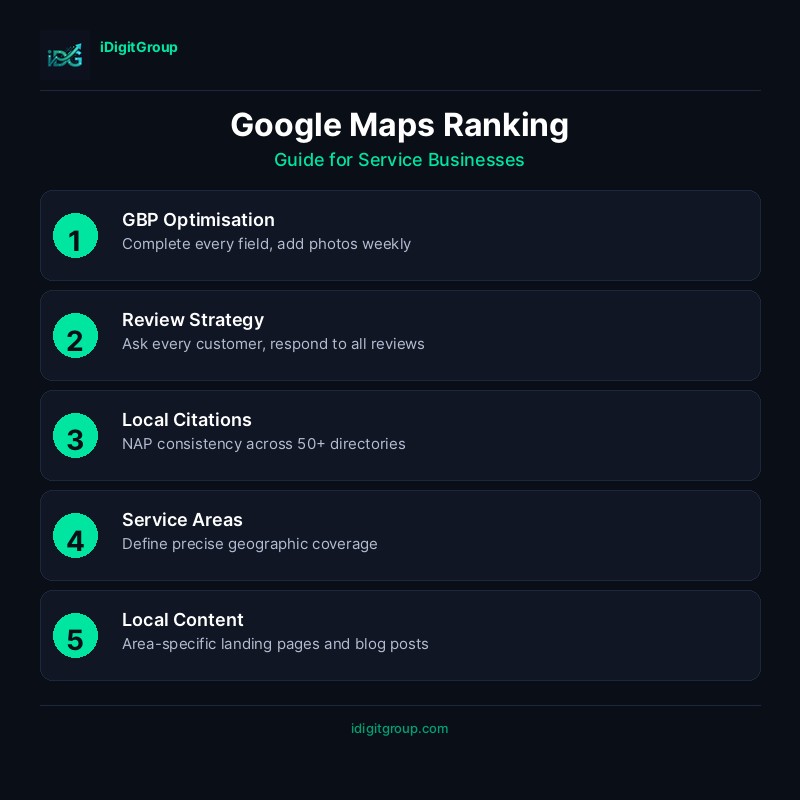
Your Google Business Profile (GBP) is the cornerstone of your Google Maps presence. A fully optimised profile significantly outperforms an incomplete one in local search rankings.
Essential Profile Elements
Every field in your Google Business Profile should be completed accurately and thoroughly. Incomplete profiles signal to Google that your business may not be active or trustworthy.
| Element | Best Practice |
|---|---|
| Business name | Exact legal business name (no keyword stuffing) |
| Primary category | Most specific category that describes your core service |
| Secondary categories | All relevant additional categories |
| Business description | 750 characters using natural keywords |
| Address | Exact, consistent address matching all citations |
| Phone number | Local phone number (not toll-free) |
| Website URL | Link to your homepage or relevant landing page |
| Hours of operation | Accurate and updated, including special hours |
| Service area | Defined for service-area businesses |
| Attributes | All relevant attributes selected |
Categories and Services
Your primary category is the single most important ranking factor within your GBP. Choose the most specific category available that accurately describes your main service. A "Personal Injury Solicitor" will outrank a generic "Solicitor" for personal injury searches.
Add all relevant secondary categories, but do not add categories for services you do not actually provide. Google's algorithms detect and penalise category spam.
Google Business Profile Posts
Regular GBP posts signal to Google that your business is active and engaged. Publish posts at least weekly, covering offers, events, updates, and useful tips. Each post should include a high-quality image, a compelling description, and a clear call to action.
Review Strategy for Google Maps
Reviews are one of the most powerful ranking factors for Google Maps. Businesses with more reviews and higher ratings consistently outrank competitors with fewer or lower-quality reviews.
The Impact of Reviews on Rankings
| Review Metric | Ranking Impact |
|---|---|
| Total review count | High, more reviews signal popularity |
| Average star rating | High: 4.0+ is the threshold for visibility |
| Review velocity | Medium: consistent new reviews signal ongoing quality |
| Review recency | Medium: recent reviews carry more weight |
| Review responses | Medium, responding signals active management |
| Review keywords | Low-Medium: reviews mentioning services help relevance |
Building a Sustainable Review Strategy
The most effective review strategies make it easy and natural for satisfied customers to leave feedback. Send a follow-up message after every completed service with a direct link to your Google review page. Time your request when satisfaction is highest, immediately after a successful outcome.
Never incentivise reviews with discounts or rewards, as this violates Google's policies and can result in review removal or profile suspension. Instead, focus on delivering exceptional service and making the review process as frictionless as possible.
Responding to Every Review
Respond to every review, positive and negative. Thank positive reviewers specifically for what they mentioned. For negative reviews, respond professionally, acknowledge the concern, and offer to resolve the issue offline. Your responses are visible to potential customers and demonstrate how you handle feedback.
Citation Building and NAP Consistency
Citations are mentions of your business name, address, and phone number (NAP) across the web. Consistent citations across authoritative directories reinforce your business's legitimacy and improve Google Maps rankings.
Priority Citation Sources
| Directory | Priority | Industry |
|---|---|---|
| Google Business Profile | Essential | All |
| Bing Places | High | All |
| Apple Maps | High | All |
| Yell.com | High | UK businesses |
| Thomson Local | High | UK businesses |
| Yelp | High | All |
| Facebook Business | High | All |
| Industry-specific directories | High | Varies |
| Local chamber of commerce | Medium | All |
| Local newspaper directories | Medium | All |
NAP Consistency
Your business name, address, and phone number must be identical across every citation. Even minor inconsistencies, such as "Street" versus "St." or different phone number formats, can confuse search engines and weaken your local ranking signals.
Conduct a citation audit to identify and correct inconsistencies. Use a consistent format across all platforms and update all citations whenever your business details change.
Local Content Strategy
Creating locally-focused content helps your website rank for location-specific searches and supports your Google Maps presence.
Service Area Pages
If your business serves multiple areas, create dedicated pages for each location you serve. Each page should include unique content about the services you provide in that specific area, local landmarks and references, and a clear call to action.
Avoid creating thin, templated location pages that differ only in the city name. Each page should provide genuine value to someone searching for your services in that area.
Local Blog Content
Blog content that references local events, news, and community involvement signals local relevance to search engines. Write about local industry trends, community partnerships, and area-specific advice that demonstrates your connection to the communities you serve.
Your local SEO strategy should include a consistent programme of locally-focused content creation.
Technical Local SEO
Several technical factors influence your Google Maps rankings and should be addressed as part of your local SEO foundation.
Local Schema Markup
Implement LocalBusiness schema markup on your website to help search engines understand your business type, location, and services. Include your business name, address, phone number, opening hours, and service area in structured data format.
Mobile Optimisation
Over 60% of local searches happen on mobile devices, and users searching on mobile are often ready to take immediate action. Ensure your website loads quickly on mobile, displays your phone number prominently with click-to-call functionality, and provides easy access to directions.
Website and GBP Alignment
The information on your website must match your Google Business Profile exactly. Discrepancies between your website and GBP, in business name, address, phone number, or services, can harm your rankings. Display your NAP prominently on every page of your website, ideally in the footer and on a dedicated contact page.
Tracking Google Maps Performance
Measuring your Google Maps performance helps you understand what is working and where to focus your efforts.
Key Metrics to Monitor
| Metric | Source | What It Tells You |
|---|---|---|
| Search impressions | GBP Insights | How often your listing appears |
| Search queries | GBP Insights | What terms trigger your listing |
| Direction requests | GBP Insights | Purchase intent signals |
| Phone calls | GBP Insights | Direct lead generation |
| Website clicks | GBP Insights | Traffic from Maps to your site |
| Photo views | GBP Insights | Engagement with visual content |
| Local Pack position | Rank tracking tool | Your competitive position |
Competitive Analysis
Monitor your competitors' Google Maps presence regularly. Track their review counts, ratings, posting frequency, and category selections. Identify gaps in their strategy that you can exploit and strengths you need to match or exceed.
Frequently Asked Questions
How long does it take to rank in the Google Maps Local Pack?
New businesses typically take three to six months to appear in the Local Pack for competitive terms. Established businesses with existing citations and reviews can see improvements within weeks of optimising their GBP. Consistency and patience are key, local SEO is a long-term investment.
Can I rank in Google Maps without a physical office?
Yes. Service-area businesses (SABs) that travel to customers can rank in Google Maps without displaying a physical address. Set up your GBP as a service-area business and define the areas you serve. Your listing will appear for searches within your defined service area.
How many reviews do I need to rank in the Local Pack?
There is no fixed number, as it depends on your competition. In less competitive markets, 20-30 reviews may be sufficient. In competitive urban areas, you may need 100+ reviews to compete. Focus on consistently generating new reviews rather than hitting a specific number.
Should I use my home address for my Google Business Profile?
If you operate from home and do not receive customers at your home address, set up your GBP as a service-area business and hide your address. Google allows this for businesses that travel to customers. Never use a virtual office or PO box, as these violate Google's guidelines.
How do fake reviews affect my Google Maps ranking?
Fake reviews, both positive and negative, violate Google's policies. Purchasing fake positive reviews can result in review removal, profile suspension, or permanent delisting. If you receive fake negative reviews, report them through your GBP dashboard and respond professionally while the review is under investigation.
Conclusion
Ranking in Google Maps is one of the most impactful things a service business can achieve for its online visibility. By optimising your Google Business Profile, building a strong review portfolio, maintaining consistent citations, and creating locally-relevant content, you can position your business to capture the high-intent local searches that drive real revenue.
The businesses that succeed in local search are those that treat Google Maps optimisation as an ongoing discipline rather than a one-time setup. Consistent effort across all the factors covered in this guide will compound over time, building a local presence that is difficult for competitors to displace. Contact us to discuss how we can help your service business dominate local search.