
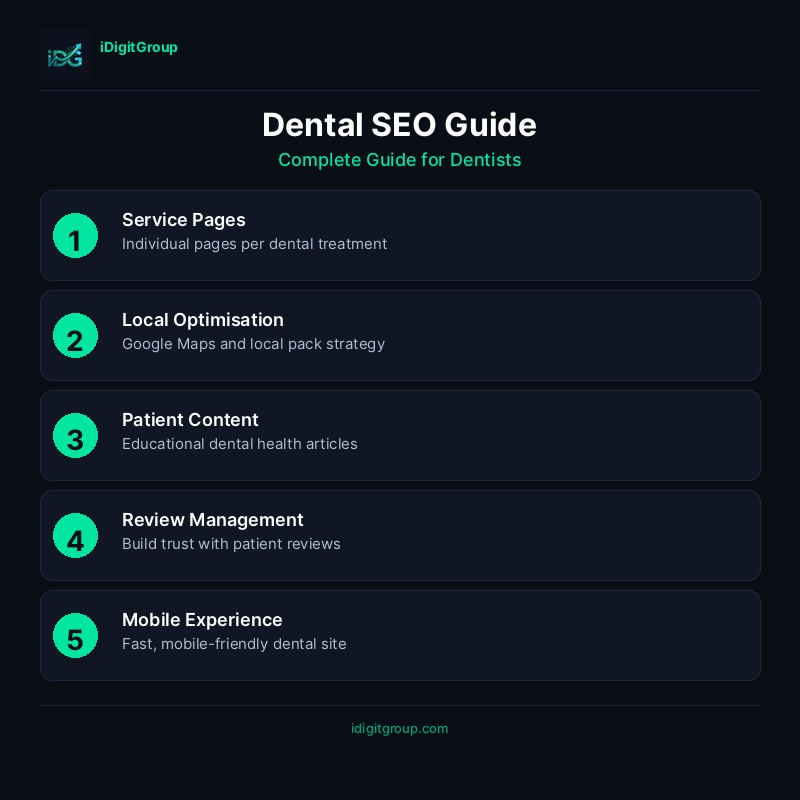
Introduction: Why Your Dental Practice Needs a Robust SEO Strategy
Dental SEO is the practice of optimising a dental practice's website and online visibility so it ranks higher on Google for the searches prospective patients actually use: things like "dentist near me," "emergency dentist London," or "Invisalign cost." For a dental practice, this means a combination of local search optimisation (Google Business Profile, citations, reviews), on-page content that answers patient questions, and technical foundations that let Google crawl and understand the site properly. With potential patients increasingly turning to search engines to find local healthcare providers, a practice that ranks well in its area converts that visibility directly into booked appointments, while a practice with no SEO strategy stays invisible regardless of how good its clinical care is. This guide provides a comprehensive overview of dental SEO, offering actionable strategies to improve your practice's online presence, attract more patients, and achieve sustainable growth. From mastering local search to creating compelling content, we'll cover everything you need to know to succeed in the competitive world of dental marketing.
On-Page SEO: The Foundation of Your Online Presence
On-page SEO refers to the practice of optimizing individual web pages to rank higher and earn more relevant traffic in search engines. For dental practices, this means ensuring your website's content and structure are aligned with what potential patients are searching for.
Keyword Research for Dental Practices
Effective SEO starts with understanding the keywords and phrases your target audience is using. These can be broadly categorized into:
* Navigational Keywords: Used to find a specific website (e.g., "iDigitGroup dental marketing"). * Informational Keywords: Used to find information (e.g., "what is the cost of dental implants"). * Transactional Keywords: Used when a user is ready to make a purchase or book an appointment (e.g., "emergency dentist in London").
| Keyword Type | Example | Intent |
|---|---|---|
| Branded | "Your Practice Name" | Navigational |
| Service-Oriented | "Invisalign London" | Transactional |
| Problem-Oriented | "toothache relief" | Informational |
| Location-Based | "dentist near me" | Transactional |
Optimizing Your Website Content
Once you've identified your target keywords, it's time to incorporate them into your website's content. This includes:
* Title Tags: The title of each page, which appears in browser tabs and search results. * Meta Descriptions: A brief summary of the page's content, which appears under the title in search results. * Header Tags (H1, H2, H3): Used to structure your content and signal its importance to search engines. * Body Content: The main text of the page, where you can naturally incorporate your target keywords.
Remember to write for humans first and search engines second. Your content should be informative, engaging, and easy to read.
Local SEO: Winning the Neighborhood
For most dental practices, local SEO is the most critical component of their digital marketing strategy. It's all about making your practice visible to potential patients in your immediate geographic area.
Google Business Profile: Your Digital Front Door
Your Google Business Profile (GBP) is a free tool that allows you to manage how your practice appears on Google Search and Maps. A fully optimized GBP is essential for local SEO success. For more details, check out our Google Business Profile guide.
Key optimization strategies include:
* Complete and Accurate Information: Ensure your practice's name, address, phone number, and hours are correct and consistent across the web. * Engaging Business Description: Write a compelling description of your practice, highlighting your unique selling points and incorporating relevant keywords. * High-Quality Photos: Upload professional photos of your practice, team, and equipment to give potential patients a sense of your brand and environment. * Regular Posts: Share updates, special offers, and blog posts to keep your profile fresh and engaging.
The Power of Patient Reviews
Online reviews are a powerful tool for building trust and credibility. Encourage your satisfied patients to leave reviews on your GBP and other relevant platforms. Respond to all reviews, both positive and negative, to show that you value patient feedback.
Off-Page SEO: Building Your Practice's Authority
Off-page SEO refers to actions taken outside of your own website to impact your rankings within search engine results pages. It's about building your practice's authority and credibility in the eyes of search engines.
Link Building for Dentists
Backlinks, links from other websites to yours, are a crucial ranking factor. The more high-quality backlinks you have, the more authoritative your website will appear to Google. For a deeper dive, read our dental implants SEO guide.
Effective link-building strategies for dentists include:
* Guest Blogging: Write articles for other relevant websites in your industry. * Local Citations: Get your practice listed in online directories like Yelp, and other local business directories. * Community Engagement: Sponsor local events or charities to earn backlinks from their websites.
Social Media for Dental Practices
While social media may not directly impact your search rankings, it's a valuable tool for building brand awareness and driving traffic to your website. Share your blog posts, patient testimonials, and behind-the-scenes content to engage with your audience and build a loyal following.
Technical SEO: The Nuts and Bolts of a Healthy Website
Technical SEO involves optimizing your website's technical aspects to improve its crawling and indexing by search engines. A technically sound website is the foundation of any successful SEO strategy.
Website Speed and Mobile-Friendliness
In today's fast-paced digital world, users expect websites to load quickly and be easy to use on any device. A slow or mobile-unfriendly website can lead to a poor user experience and a high bounce rate, which can negatively impact your search rankings.
Schema Markup for Dentists
Schema markup is a type of code that you can add to your website to help search engines better understand your content. For dental practices, this can include schema for your practice's name, address, phone number, and patient reviews. To learn more about the factors that influence your local search ranking, check out our article on local SEO ranking factors.
Conclusion: Your Path to Dental SEO Success
SEO is a long-term strategy that requires patience and persistence. By implementing the on-page, off-page, and technical SEO strategies outlined in this guide, you can improve your practice's online visibility, attract more patients, and achieve sustainable growth. For those looking for a more in-depth resource, our complete guide to SEO for dentists is a great next step.
Related Services
* SEO Services * Local SEO and Discovery * Dental Practice SEO