
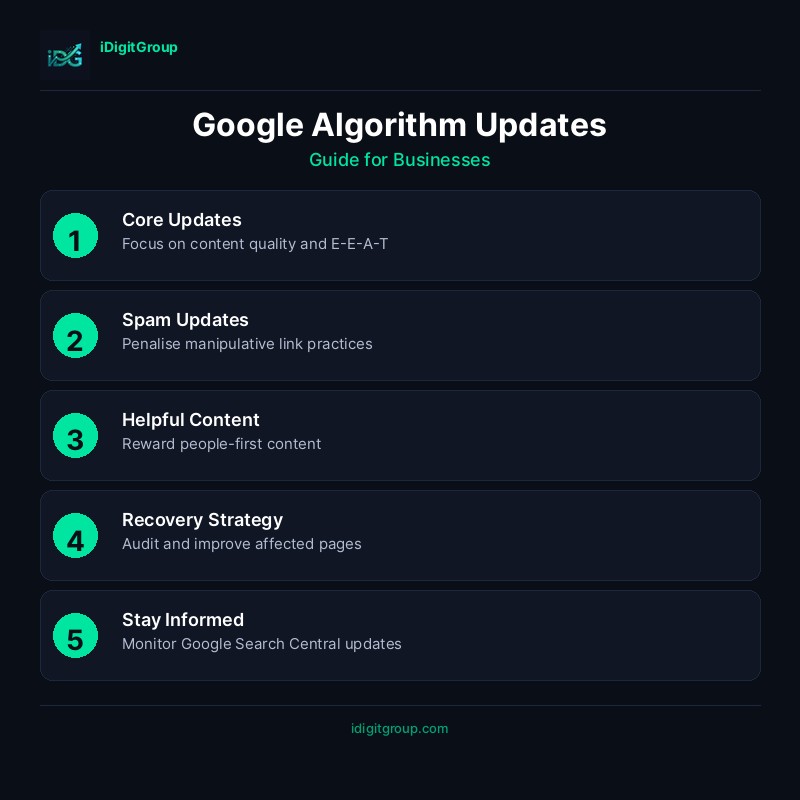
Introduction: What Are Google Algorithm Updates and Why Do They Matter?
A Google algorithm update is a change Google makes to the systems that determine which pages rank for a given search: ranging from minor daily tweaks to major "core updates" that can reshuffle rankings across entire industries overnight. Google makes thousands of small adjustments every year, but it's the handful of broad, named updates (Panda, Penguin, the Helpful Content Update, and others) that businesses need to track, because these are designed to reward higher-quality, more trustworthy content and can cause significant, lasting shifts in visibility for sites that don't meet the new bar. For any business relying on Google Search for visibility, understanding what these updates target and how to adapt is not optional: a site built on outdated SEO tactics can lose the bulk of its organic traffic in a single update cycle. As Google itself puts it: "Several times a year, Google makes significant, broad changes to our search algorithms and systems. We refer to these as 'core updates.' They're designed to ensure that overall, we're delivering on our mission to present relevant and authoritative content to searchers."
"Several times a year, Google makes significant, broad changes to our search algorithms and systems. We refer to these as 'core updates.' They're designed to ensure that overall, we're delivering on our mission to present relevant and authoritative content to searchers." - Google Search Central
This guide provides a comprehensive overview of Google's major algorithm updates, their impact on SEO, and how your business can navigate this dynamic landscape to build a resilient and successful digital strategy. From historical shifts to the latest AI-driven changes, we will equip you with the knowledge to thrive in the face of algorithmic evolution.
The Evolution of Google's Search Algorithm: A Brief History
Google's journey from a simple search engine to the complex, AI-driven system it is today is a story of continuous innovation. In the early days, its algorithm was relatively basic, relying heavily on keyword density and backlinks. This led to an era of "keyword stuffing" and manipulative link-building schemes, where the focus was on gaming the system rather than providing value to the user.
The introduction of PageRank was a significant turning point. This algorithm, named after co-founder Larry Page, assigned a value to a page based on the quantity and quality of other pages linking to it. It was a revolutionary concept that helped to bring a sense of order and authority to the web. However, it was still susceptible to manipulation.
The real paradigm shift began with a series of major updates designed to combat spam and reward high-quality content. The Panda update in 2011 was the first major blow to low-quality content farms and thin affiliate sites. A year later, the Penguin update targeted manipulative link-building practices, penalizing sites with unnatural backlink profiles. These updates marked a fundamental change in Google's philosophy: the focus was no longer just on what a page was about, but on its quality, authority, and trustworthiness.
A Timeline of Major Google Algorithm Updates
The following table highlights some of the most significant Google algorithm updates that have shaped the SEO landscape over the years. While this list is not exhaustive, it covers the key changes that every digital marketer should understand.
| Update Name | Year | Focus | Impact on SEO |
|---|---|---|---|
| Panda | 2011 | Content Quality | Penalized thin, low-quality content, and content farms. Emphasized the need for unique, valuable, and well-researched content. |
| Penguin | 2012 | Link Quality | Targeted manipulative and spammy link-building practices, such as paid links and link schemes. Increased the importance of natural, authoritative backlinks. |
| Hummingbird | 2013 | Semantic Search | Moved beyond keywords to understand the intent and context behind user queries. Enabled Google to deliver more relevant results for conversational and complex searches. |
| Pigeon | 2014 | Local Search | Improved the quality and relevance of local search results by integrating Google's core algorithm with its local search algorithm. Increased the importance of a strong Google Business Profile. |
| Mobilegeddon | 2015 | Mobile-Friendliness | Prioritized mobile-friendly websites in mobile search results. Made responsive design a critical ranking factor. |
| RankBrain | 2015 | Machine Learning | Introduced a machine learning system to help process and understand search queries, especially those that are ambiguous or have never been seen before. |
| BERT | 2019 | Natural Language Processing | Enabled Google to better understand the nuances and context of words in search queries, leading to more accurate and relevant results. |
| Helpful Content Update | 2022 | User-centric Content | Designed to reward content that is created for people, not for search engines. Penalized content that is unhelpful, unoriginal, or created primarily for ranking purposes. |
| Core Updates | Ongoing | Overall Improvements | Broad changes to the core algorithm that happen several times a year. These updates are designed to improve the overall quality and relevance of search results. |
Deep Dive: Understanding Google's Core Updates
While named updates like Panda and Penguin grab the headlines, Google's Core Updates are arguably the most significant changes to the search landscape. These are broad, systemic updates to the entire algorithm, rolled out several times a year. Unlike the more targeted updates of the past, Core Updates are not about fixing a single issue; they are about improving the overall quality and relevance of search results.
Google's guidance on Core Updates is consistent: there's no single "fix" if your site's performance drops after one. Instead, the focus should be on creating the best possible content and user experience. This is where the concept of E-A-T (Expertise, Authoritativeness, and Trustworthiness) comes into play. While not a direct ranking factor, E-A-T is a framework that Google's quality raters use to assess the quality of search results. Sites that demonstrate strong E-A-T signals are more likely to perform well in the long run.
Think of a Core Update as Google raising its standards. What was considered high-quality content yesterday might not be good enough today. The key to navigating these updates is a commitment to continuous improvement and a deep understanding of your audience's needs.
How to Diagnose and Recover from a Google Algorithm Update
A sudden drop in organic traffic can be alarming, but it doesn't have to be a catastrophe. By following a structured approach, you can diagnose the issue and create a plan for recovery.
| Step | Action | Description |
|---|---|---|
| 1. Identify the Update | Correlate traffic drops with known update timelines. | Use tools like Google Analytics and industry news sources to see if your traffic drop coincides with a confirmed or unconfirmed Google update. |
| 2. Analyze the Impact | Which pages or sections of your site were affected? | Dig into your analytics to identify the specific pages, keywords, or sections of your site that have lost the most traffic. This will provide clues about the nature of the update. |
| 3. Understand the Update's Focus | What type of content or practice was targeted? | Research the update to understand its goals. Was it focused on content quality, link building, user experience, or something else? |
| 4. Create an Action Plan | Develop a strategy for addressing the issues. | Based on your analysis, create a detailed action plan. This might include improving content quality, disavowing toxic backlinks, enhancing user experience, or focusing on E-A-T signals. For a comprehensive site review, consider our SEO audit services. |
| 5. Be Patient | Recovery takes time. | Recovery from an algorithm update is not instantaneous. It can take weeks or even months to see the results of your efforts. Focus on making sustainable improvements, not quick fixes. |
The Future of Search: What to Expect from Google
The world of search is in a constant state of flux, and the pace of change is only accelerating. The future of search will be defined by the increasing role of artificial intelligence (AI) and machine learning. We are already seeing this with technologies like RankBrain and BERT, which help Google to understand the nuances of human language. The recent introduction of AI Overviews and other generative AI features in search results is a clear indication of the direction Google is heading.
For businesses, this means that the traditional focus on keywords will become less important. The emphasis will shift to creating content that is truly helpful, engaging, and conversational. The websites that succeed in the future will be those that can answer users' questions directly and provide a seamless and intuitive user experience. For more on this, see our guide on AI for marketing.
Conclusion: Thriving in an Ever-Changing SEO Landscape
Google's algorithm will continue to evolve, but the fundamental principles of good SEO remain constant. The key to long-term success is to focus on creating high-quality, user-centric content that demonstrates expertise, authoritativeness, and trustworthiness. Instead of chasing algorithms, chase your audience. Understand their needs, answer their questions, and provide them with a valuable and engaging experience.
By staying informed about the latest trends in search and committing to a strategy of continuous improvement, your business can not only survive but thrive in the ever-changing SEO landscape. The businesses that embrace this philosophy will be the ones that build a sustainable and successful digital future.
---
Related Services
- SEO Services - Our comprehensive SEO services are designed to increase your visibility and drive organic growth.
- Content Marketing - We create high-quality, engaging content that resonates with your audience and builds your brand.
- Digital Strategy - Let us help you develop a holistic digital strategy that aligns with your business goals.