
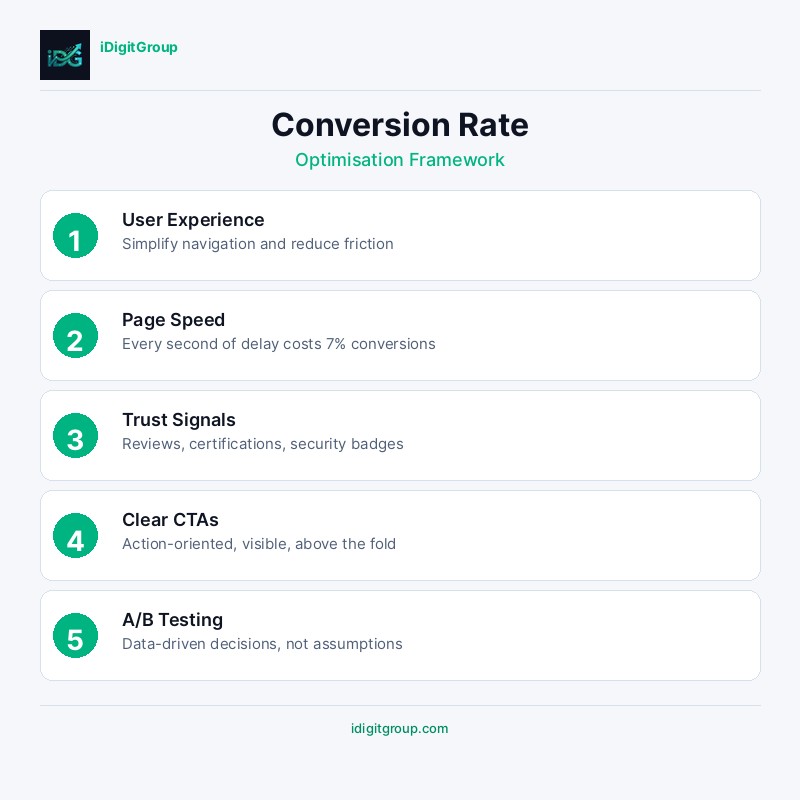
Understanding Conversion Rate Optimisation
Doubling your conversion rate is mathematically equivalent to doubling your traffic: but it typically costs a fraction as much to achieve. Most businesses invest heavily in getting more visitors while leaving the revenue sitting in the existing traffic they already have. The average website converts at 2 to 3%. Elite performers in the same sectors convert at 8 to 12%. The gap is almost never about the product or the price, it's about how the website presents, builds trust, and guides visitors towards a decision. This guide covers the specific elements that move that number.
Improving your conversion rate is one of the highest-ROI activities in digital marketing. Unlike driving more traffic, which requires ongoing investment, CRO extracts more value from the traffic you already have. A website converting at 4% generates twice the revenue of one converting at 2%, without spending a single additional pound on advertising or SEO.
This guide covers the fundamental principles and proven strategies for improving your website's conversion rate, from understanding user behaviour to implementing systematic testing frameworks.
Analysing Your Current Conversion Performance
Before making changes, you need a clear picture of how your website currently performs. Data-driven CRO begins with measurement.
Key Conversion Metrics
| Metric | Definition | Benchmark |
|---|---|---|
| Conversion rate | Visitors who complete desired action | 2-5% (varies by industry) |
| Bounce rate | Single-page sessions | Under 40% is good |
| Exit rate | Percentage leaving from a specific page | Varies by page type |
| Average session duration | Time spent on site | Over 2 minutes |
| Pages per session | Number of pages viewed | Over 2 pages |
| Cart abandonment rate | Users who add to cart but don't purchase | 70% average |
Setting Up Proper Tracking
Accurate conversion tracking is non-negotiable. Implement event tracking for every meaningful user action: form submissions, button clicks, phone calls, downloads, and purchases. Without proper tracking, you are optimising blind.
Use heatmaps and session recordings to understand how users actually interact with your pages. These tools reveal where users click, how far they scroll, and where they get stuck, insights that quantitative data alone cannot provide.
Landing Page Optimisation
Landing pages are where conversions happen or fail. Every element on a landing page should serve a single purpose: moving the visitor toward the desired action.
The Anatomy of a High-Converting Landing Page
A high-converting landing page follows a proven structure that guides the visitor's attention and builds momentum toward conversion.
Above the fold, visitors should immediately understand three things: what you offer, why it matters to them, and what they should do next. This means a clear headline, a supporting subheadline, and a prominent call to action, all visible without scrolling.
Below the fold, provide the evidence and detail that supports the above-the-fold promise. This includes benefits (not just features), social proof, detailed explanations, and additional calls to action.
Headlines That Convert
Your headline is the single most important element on any landing page. It determines whether visitors stay or leave within the first five seconds. Effective headlines are specific, benefit-oriented, and address the visitor's primary concern.
| Weak Headline | Strong Headline |
|---|---|
| "Welcome to Our Website" | "Grow Your Organic Traffic by 200% in 6 Months" |
| "Our Services" | "SEO Services That Actually Deliver Results" |
| "Contact Us" | "Get Your Free SEO Audit in 24 Hours" |
| "About Our Company" | "Trusted by 500+ Businesses Across the UK" |
Call-to-Action Optimisation
Your call to action (CTA) must be visually prominent, action-oriented, and specific. Replace generic CTAs like "Submit" or "Click Here" with value-driven alternatives like "Get My Free Audit," "Start Growing Today," or "Book My Consultation."
CTA placement matters as much as wording. Include your primary CTA above the fold and repeat it at logical intervals throughout the page. For long-form pages, include a CTA after every major section.
User Experience and Design
The design and usability of your website directly impact conversion rates. A beautiful website that is difficult to navigate will underperform a simpler site with intuitive user experience.
Navigation and Information Architecture
Users should be able to find what they are looking for within three clicks. Simplify your navigation menu, use descriptive labels, and ensure your most important pages are prominently accessible. For a deeper dive into UX principles, read our guide on UX/UI conversion optimisation.
Form Optimisation
Forms are conversion bottlenecks. Every additional field reduces completion rates. Audit your forms and remove any field that is not absolutely necessary for the initial conversion. You can always collect additional information later.
| Form Length | Typical Conversion Impact |
|---|---|
| 1-3 fields | Highest conversion rate |
| 4-6 fields | Moderate drop (10-20%) |
| 7-10 fields | Significant drop (30-50%) |
| 10+ fields | Severe drop (50%+) |
Mobile Conversion Optimisation
Mobile users now account for over 60% of web traffic, yet mobile conversion rates are typically half that of desktop. This gap represents a massive opportunity. Optimise your mobile experience with larger tap targets, simplified forms, mobile-specific CTAs (such as click-to-call buttons), and streamlined checkout processes.
Your web design should prioritise mobile conversion from the outset, not treat it as an afterthought.
Trust Signals and Social Proof
Trust is the foundation of conversion. Visitors will not convert if they do not trust your business, your website, or your ability to deliver on your promises.
Types of Trust Signals
| Trust Signal | Impact | Implementation |
|---|---|---|
| Customer testimonials | High | Feature on landing pages with names and photos |
| Case studies | Very high | Detailed results with specific metrics |
| Industry certifications | Medium | Display logos prominently |
| Security badges | High (for e-commerce) | Show near payment forms |
| Review scores | Very high | Aggregate ratings from Google, Trustpilot |
| Client logos | Medium | Display recognisable brands you have worked with |
| Money-back guarantee | High | Reduce perceived risk |
Leveraging Social Proof Effectively
Social proof is most effective when it is specific, relevant, and recent. "We have helped 500 businesses" is good. "We increased organic traffic by 340% for a dental practice in Chelsea" is far more compelling. Use case studies and testimonials that match the visitor's industry and situation whenever possible.
Page Speed and Conversion
Page speed has a direct, measurable impact on conversion rates. Research consistently shows that faster pages convert better.
| Load Time | Conversion Impact |
|---|---|
| 1 second | Baseline |
| 2 seconds | 7% lower conversion |
| 3 seconds | 11% lower conversion |
| 5 seconds | 38% lower conversion |
| 10 seconds | 65% lower conversion |
A/B Testing Framework
A/B testing is the scientific method applied to conversion optimisation. Rather than guessing what will improve conversions, you test variations against each other and let the data decide.
What to Test
Prioritise tests based on potential impact and ease of implementation. High-impact elements to test include:
- Headlines and value propositions
- Call-to-action text, colour, and placement
- Form length and field order
- Page layout and content structure
- Pricing presentation
- Image selection and placement
- Social proof placement and format
Testing Best Practices
Run tests for a minimum of two weeks or until you reach statistical significance (typically 95% confidence). Test one variable at a time to isolate the impact of each change. Document every test, including failures, to build an institutional knowledge base of what works for your audience.
Avoiding Common Testing Mistakes
- Testing too many variables simultaneously: Makes it impossible to identify what caused the change
- Ending tests too early: Small sample sizes produce unreliable results
- Ignoring segmentation: A change that improves conversion for mobile users might harm desktop conversion
- Not testing the obvious: Sometimes the biggest wins come from testing fundamental elements like headlines and CTAs
Personalisation and Dynamic Content
Personalisation increases conversion rates by delivering relevant experiences to different audience segments. Even basic personalisation, such as showing different content to new versus returning visitors, can significantly impact conversion rates.
Personalisation Strategies
- Geographic personalisation: Show location-relevant content, pricing, and offers
- Behavioural personalisation: Adapt content based on previous site interactions
- Source-based personalisation: Tailor landing pages to match the referring source
- Device-based personalisation: Optimise the experience for the visitor's device
Frequently Asked Questions
What is a good conversion rate for a website?
Conversion rates vary significantly by industry and conversion type. For lead generation websites, 2-5% is typical, with top performers achieving 10%+. For e-commerce, 1-3% is average. Rather than comparing to industry benchmarks, focus on continuously improving your own conversion rate through systematic testing.
How quickly can I improve my conversion rate?
Some improvements, such as fixing broken forms, improving page speed, or adding trust signals, can deliver results within days. More strategic changes like redesigning landing pages or implementing personalisation typically take weeks to test and validate. Expect meaningful improvement within one to three months of systematic CRO work.
Should I focus on traffic or conversion rate first?
If your website already receives meaningful traffic (over 1,000 monthly visitors), focus on conversion rate first. Improving conversion from 1% to 2% doubles your results without any additional traffic investment. Once your conversion rate is optimised, increasing traffic becomes far more profitable.
Do I need expensive tools for CRO?
No. Google Analytics (free) provides essential conversion tracking. Hotjar offers a free tier for heatmaps and session recordings. Google Optimize (or its successors) provides free A/B testing capabilities. Start with free tools and invest in premium solutions only when your testing programme matures.
How does page speed affect conversion rates?
Page speed has a direct and significant impact on conversions. Studies show that a one-second delay in load time can reduce conversions by 7%. For e-commerce sites, this translates directly to lost revenue. Prioritise speed optimisation as a foundational CRO activity.
Conclusion
Conversion rate optimisation is not a one-time project, it is an ongoing discipline that compounds results over time. By systematically analysing user behaviour, testing hypotheses, and implementing proven strategies, you can dramatically increase the value of every visitor to your website.
Start with the fundamentals: ensure your pages load quickly, your value proposition is clear, your forms are frictionless, and your trust signals are prominent. Then build a culture of testing that continuously refines and improves your conversion performance. Get in touch to discuss how we can help optimise your website for maximum conversions.