
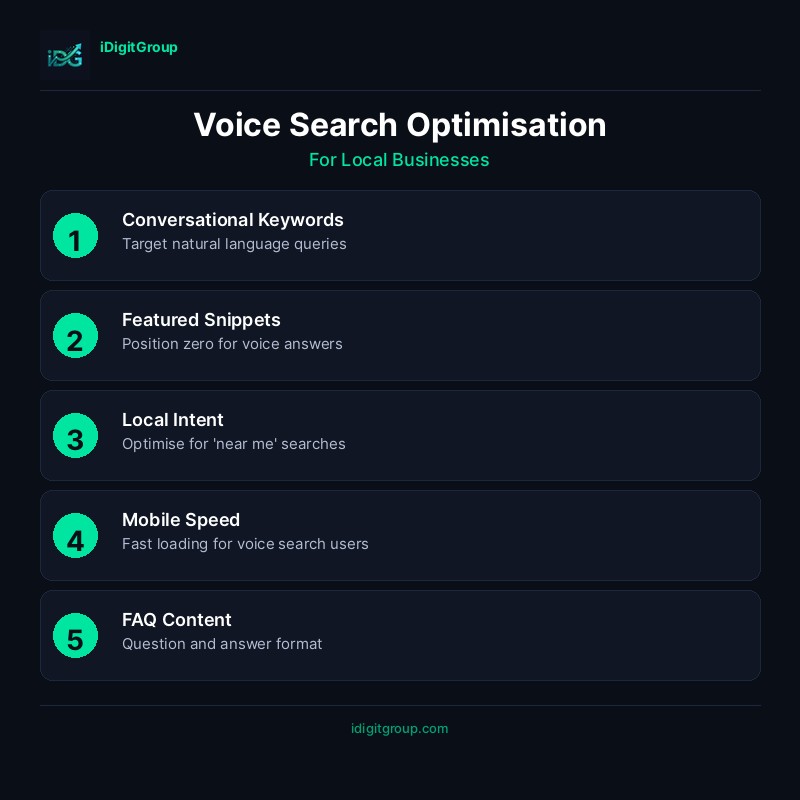
The words someone uses when they type a search query are fundamentally different from the words they use when they speak one. Typed: 'plumber Shoreditch'. Spoken: 'Who's the best plumber open right now near Shoreditch?' That difference in phrasing changes everything about which content ranks, how your business listing needs to be structured, and what questions your website should be answering. Local businesses that optimise for natural-language queries capture a growing share of high-intent searches that their competitors are simply not set up to appear for.
This guide outlines the essential strategies for optimising your local business for voice search in 2026.
Why Voice Search Matters for Local Businesses
Voice search has fundamentally changed how consumers find local businesses. With over 50% of adults using voice search daily and smart speaker ownership continuing to grow, optimising for voice queries is no longer optional for local businesses. Voice searches are inherently local: "near me" voice searches have grown by over 500% in recent years, and 58% of consumers have used voice search to find local business information. The key difference between voice and text search is that voice queries are conversational, longer, and typically phrased as questions. While a text searcher might type "dentist London", a voice searcher asks "What's the best dentist near me that's open on Saturday?" Understanding and optimising for these conversational patterns is essential for capturing voice search traffic.
Voice search queries are typically longer, more conversational, and have higher local intent than text-based searches. Users are often on the go, using mobile devices, and looking for immediate solutions. This presents a massive opportunity for local businesses that can provide direct, concise answers.
- High Local Intent: Queries like "near me," "open now," and "directions to..." are common.
- Action-Oriented: Users are often looking to make a purchase, visit a location, or contact a business.
- Dominance of Featured Snippets: Voice assistants often read out the content from the featured snippet (the "answer box" at the top of Google), making it a prime target for optimisation.
How to Optimise for Voice Search
Optimising for voice search involves a multi-faceted approach that combines technical SEO, content strategy, and local SEO best practices.
1. Target Conversational, Long-Tail Keywords
Think about how people ask questions verbally. Instead of typing "plumber London," a voice search user might ask, "Who is the best-rated plumber in East London?" Your keyword strategy needs to reflect this.
- Use Question-Based Keywords: Focus on who, what, where, when, why, and how.
- Analyse "People Also Ask": The "People Also Ask" section in Google search results is a goldmine for voice search queries.
- Use Your Own Data: Look at the queries your customers use when they call or email you.
2. Optimise Your Google Business Profile (GBP)
Your GBP is the single most important tool for local voice search. Voice assistants pull information directly from it to answer queries about your opening hours, address, phone number, and reviews.
- Complete Every Section: Ensure your NAP (Name, Address, Phone) is accurate and consistent. Fill out your services, categories, attributes, and Q&A section.
- Encourage Reviews: A steady stream of positive reviews signals to Google that you are a trusted local business.
3. Aim for the Featured Snippet (Position Zero)
Voice assistants typically read the featured snippet as their answer, making Position Zero the most valuable real estate for voice search. To win featured snippets, structure your content to directly answer common questions in a concise format. Use question-based H2 and H3 headings that match voice search queries, then provide a clear, direct answer in the first 40-60 words below the heading. Follow this with more detailed supporting information. Lists, tables, and step-by-step formats are particularly effective for featured snippet capture.
4. Optimise for Local Voice Search Queries
Local voice searches follow predictable patterns that you can optimise for. Create FAQ pages that address common voice queries like "What time does [business] close?", "Where is the nearest [business type]?", and "Does [business] offer [service]?". Ensure your Google Business Profile has complete and accurate information, as voice assistants frequently pull answers directly from GBP data. Include natural language variations of your target keywords throughout your content, focusing on the conversational phrases people actually use when speaking rather than typing.
Measuring Voice Search Performance
While direct voice search analytics remain limited, you can track voice search impact through several proxy metrics. Monitor increases in long-tail, question-based keyword traffic in Google Search Console. Track featured snippet appearances for your target queries. Analyse Google Business Profile insights for increases in "discovery" searches and direction requests. Pay attention to the types of queries driving traffic: an increase in natural language, question-format queries suggests growing voice search visibility.
For many informational queries, the voice assistant will read the answer directly from the featured snippet. Earning this position is key to voice search visibility.
- Provide Concise Answers: Structure your content to provide a direct, clear answer to a specific question at the beginning of a section.
- Use Lists and Tables: Content formatted in bulleted lists, numbered lists, or tables is often favoured for featured snippets.
- Use
FAQPageSchema: Marking up your FAQ sections with schema can help your answers get pulled directly into the SERPs.
4. Create High-Quality, Scannable Content
Voice search algorithms favour content that is easy to read and understand. This means writing in a natural, conversational tone and structuring your content for scannability.
- Short Paragraphs: Keep paragraphs to 2-3 sentences.
- Clear Headings: Use a logical heading structure (H1, H2, H3) to break up your content.
- Readability: Write at a level that is easy for most people to understand (aim for a reading level of around 8th grade).
5. Ensure Your Website is Mobile-Friendly and Fast
Most voice searches are performed on mobile devices. A slow, clunky website will kill your chances of ranking.
- Mobile-First Design: Your website must be fully responsive and provide an excellent user experience on all devices.
- Page Speed: Use Google's PageSpeed Insights tool to test and improve your loading times. Aim for a load time of under 3 seconds.
The Role of Structured Data in Voice Search
Structured data (schema markup) is crucial for voice search. It provides the explicit context that search engines need to understand your content and deliver it as a voice answer.
| Schema Type | How it Helps Voice Search |
|---|---|
LocalBusiness | Provides essential information like address, phone number, and opening hours. |
FAQPage | Allows your questions and answers to be read directly by voice assistants. |
HowTo | Provides step-by-step instructions for "how-to" queries. |
Recipe | Essential for food-related businesses, providing cooking times, ingredients, etc. |
Frequently Asked Questions (FAQ)
Q: How is voice search different from traditional SEO? A: Voice search focuses more on long-tail, conversational keywords and providing direct answers, whereas traditional SEO often targets shorter keywords and aims to earn a click through to a webpage.
Q: Do I need a smart speaker to test my voice search optimisation? A: No. You can use the voice search function on your smartphone (Google Assistant on Android, Siri on iOS) to test how your business appears for relevant queries.
Q: What is the most important thing I can do for voice search SEO? A: Fully optimising your Google Business Profile is the most impactful action you can take. It is the primary source of information for local voice queries.