
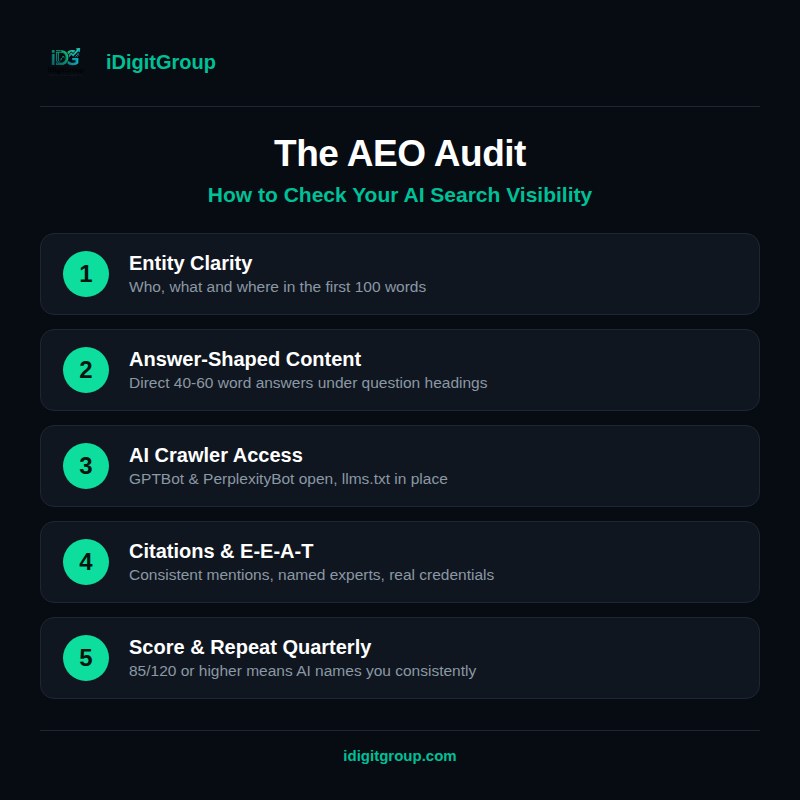
An AEO audit is a structured review of how visible, quotable and trustworthy your business looks to AI answer engines such as ChatGPT, Perplexity and Google AI Overviews. At iDigitGroup, a London based SEO and AEO agency, we run these audits for clinics, law firms and local businesses every week, and the pattern is always the same: companies that rank well on Google often assume AI assistants recommend them too, then discover they are invisible in the exact answers their customers now read. This guide gives you the complete audit methodology we use internally, an 8 point checklist you can run yourself in under an hour, and a scoring system that tells you exactly where to act first.
What Is an AEO Audit?
An AEO audit is a systematic check of whether AI answer engines can find, understand, trust and cite your business when users ask questions your products or services answer. It reviews eight areas: entity clarity, structured data, answer shaped content, AI crawler access, server rendered HTML, brand citations, E-E-A-T signals and content freshness.
Where a classic SEO audit asks "can this site rank in a list of blue links?", an AEO audit asks a harder question: "when an AI writes the answer itself, does it mention us?". The two overlap, because AI systems lean heavily on well structured, authoritative pages, but they are not the same discipline. A site can hold position 3 on Google and still never appear in an AI generated answer, because assistants compress the entire results page into a few sentences and only name the businesses they can identify and verify with confidence.
If AEO itself is new to you, start with our complete guide to Answer Engine Optimisation, then come back here to measure where you stand.
Why AI Visibility Now Decides Who Wins the Customer
AI assistants have moved from novelty to habit. ChatGPT alone serves over 800 million weekly users, and Google AI Overviews now appear across a substantial share of informational searches in the UK. When someone asks "best aesthetic clinic in Marylebone" or "which SEO agency should I use in Manchester", the answer increasingly arrives as a short written recommendation, not a page of links.
That changes the economics of visibility in three ways:
- Fewer clicks, higher stakes. An AI answer names two or three businesses. Either you are in that shortlist or you do not exist for that user.
- Recommendations feel vetted. Users treat an assistant naming your brand as an endorsement, which carries more trust than an ad or a high ranking alone.
- The gap compounds quietly. Businesses cited today are used as training and grounding references for tomorrow's answers, so early visibility earns compounding returns.
How Do You Check If ChatGPT Recommends Your Business?
The fastest check is to ask the assistants the questions your customers ask, in a clean session with no history, and record whether your brand is named. Test at least three platforms (ChatGPT, Perplexity and Google AI Overviews) because each one selects sources differently.
Build your prompt set from four intent groups:
| Prompt type | Example | What it reveals |
|---|---|---|
| Best of | "Best [service] in [city]?" | Whether you make the AI shortlist |
| Comparison | "[Your brand] vs [competitor], which is better?" | Whether the AI knows your strengths |
| Problem | "How do I fix [problem you solve]?" | Whether your content is used as the answer |
| Direct | "What is [your brand] and is it reputable?" | Whether your entity is understood and trusted |
For a faster start, our free AEO Checker runs this style of visibility check for your domain and highlights the technical gaps in minutes, with no login required.
The 8 Point AEO Audit Checklist
Work through the eight checks in order. Each one includes the pass signal we look for when auditing client sites.
1. Entity clarity
Open your homepage and your key service pages. Within the first 100 words, can a machine tell exactly who you are, what you do and where you operate? Pass signal: the brand name, primary service and location appear together in plain, quotable language, and your Organization or LocalBusiness schema carries a stable @id plus sameAs links to your Google Business Profile and social profiles.
2. Structured data graph
AI crawlers parse Schema.org markup as a fact source, not decoration. Pass signal: WebSite, Organization, WebPage and Article or Service nodes exist on the relevant pages, validate without errors, and reference each other through @id links so they form one connected graph rather than isolated fragments. Our schema markup guide for local businesses covers the exact patterns.
3. Answer shaped content
Assistants lift concise, self contained passages. Pass signal: every important page answers its core question in 40 to 60 words directly beneath a question style heading, before expanding into detail. Definitions, numbered steps and comparison tables all raise the odds of being quoted verbatim.
4. AI crawler access and llms.txt
Some sites block the crawlers that feed answer engines without realising it. Pass signal: robots.txt does not disallow GPTBot, PerplexityBot, ClaudeBot or Google-Extended (unless that is a deliberate policy decision), and an llms.txt file at the domain root summarises who you are, what you offer and which pages matter most.
5. Server rendered content
If your content only exists after JavaScript runs, many AI crawlers never see it. Pass signal: viewing the raw page source (not the browser inspector) shows your full text, headings and schema in the initial HTML response.
6. Citations and brand mentions
Assistants cross check entities against the wider web. Pass signal: your business appears with consistent name, address and phone details across authoritative directories, industry publications and review platforms, and third party pages mention your brand in context, not just in link lists. Our guide on getting cited in AI search results goes deep on earning these signals.
7. E-E-A-T and authorship
AI systems prefer sources with visible expertise and accountability. Pass signal: articles carry named authors with real credentials, an editorial policy exists, and Person schema links authors to the organisation. Anonymous content is a systematic disadvantage.
8. Freshness and factual precision
Answer engines reward sources that add verifiable information. Pass signal: dates are honest, statistics are specific and attributed, prices and service details are current, and outdated claims have been removed rather than left to rot.
How to Score Your AEO Audit
Score each of the eight checks from 0 (fails completely) to 10 (fully passes), then weight the four that move results hardest. This is the scoring model we apply in client audits:
| Audit area | Weight | Weak signal | Strong signal |
|---|---|---|---|
| Entity clarity | x2 | Brand described vaguely or inconsistently | Who, what, where machine readable everywhere |
| Answer shaped content | x2 | Long intros, buried answers | Direct answers under question headings |
| Citations and mentions | x2 | Few or inconsistent external references | Consistent mentions on authoritative sites |
| E-E-A-T and authorship | x2 | Anonymous, undated content | Named experts, credentials, editorial policy |
| Structured data graph | x1 | Missing or fragmented schema | Connected, valid schema graph |
| AI crawler access | x1 | Crawlers blocked, no llms.txt | Open access plus maintained llms.txt |
| Server rendered content | x1 | Content behind JavaScript | Full content in initial HTML |
| Freshness | x1 | Stale dates and dead facts | Current, specific, attributed information |
How Often Should You Run an AEO Audit?
Run a full AEO audit every quarter, plus a quick prompt test after any major site change, rebrand or new service launch. AI answer behaviour shifts faster than classic rankings: model updates, new crawlers and fresh training snapshots can change who gets recommended within weeks, so an annual check is no longer enough.
A practical rhythm looks like this: monthly, rerun your 12 prompt visibility test and log which brands are named. Quarterly, rescore the full 8 point checklist. Annually, review your entity strategy as a whole, including which directories, publications and platforms mention you.
Fixing the Gaps: Where to Start
Audit findings only matter if they change the order of your work. Fix in this sequence:
- Access and rendering first. If crawlers are blocked or content is client side only, nothing else counts. These are usually one day fixes with immediate effect.
- Entity clarity second. Rewrite openings so who, what and where are explicit, and repair your Organization schema. This is the foundation every other signal builds on.
- Answer shaped rewrites third. Restructure your highest value pages around question headings with direct answers. Start with pages that already earn impressions, because they are closest to being quoted. The AEO vs SEO comparison explains why this format wins.
- Authority last but longest. Citations, reviews and E-E-A-T grow over months. Begin the outreach now and let it compound while the technical fixes take effect.
Run Your First Check in Two Minutes
You now have the full methodology, but you do not need to schedule an afternoon to begin. Enter your domain into the free AEO Checker, and it will flag your most urgent gaps immediately. Then use the 8 point checklist above to plan the quarter. Businesses that measure AI visibility now will own the shortlists their competitors are still guessing about.
Frequently Asked Questions
How long does an AEO audit take?
A self run audit using the 8 point checklist takes about an hour for a typical small business site, plus 30 minutes for the prompt visibility test. A professional audit with competitor benchmarking usually takes three to five working days.
Do I need separate audits for ChatGPT and Google AI Overviews?
No. Run one audit, but test visibility on each platform separately. The underlying fixes (entity clarity, schema, answer shaped content, citations) improve visibility across all answer engines, even though each platform weighs sources slightly differently.
Can I score well in an AEO audit but still rank badly on Google?
It is possible but rare, because the disciplines share foundations. Strong AEO work tends to lift classic rankings too, since Google rewards the same clarity, structure and authority signals. The reverse is more common: good rankings with poor AI visibility.
What is a good AEO audit score to aim for?
Aim for 85 out of 120 or higher on our weighted model. Above that threshold, businesses appear consistently in AI shortlists for their core services. Under 50 means answer engines either cannot identify your entity or do not trust it enough to name it.
How much does a professional AEO audit cost?
In the UK, professional AEO audits typically range from a few hundred pounds for a focused technical review to several thousand for a full competitive study with an implementation roadmap. Ours are included within our AEO service plans, so the audit cost rolls into the work that fixes what it finds.