
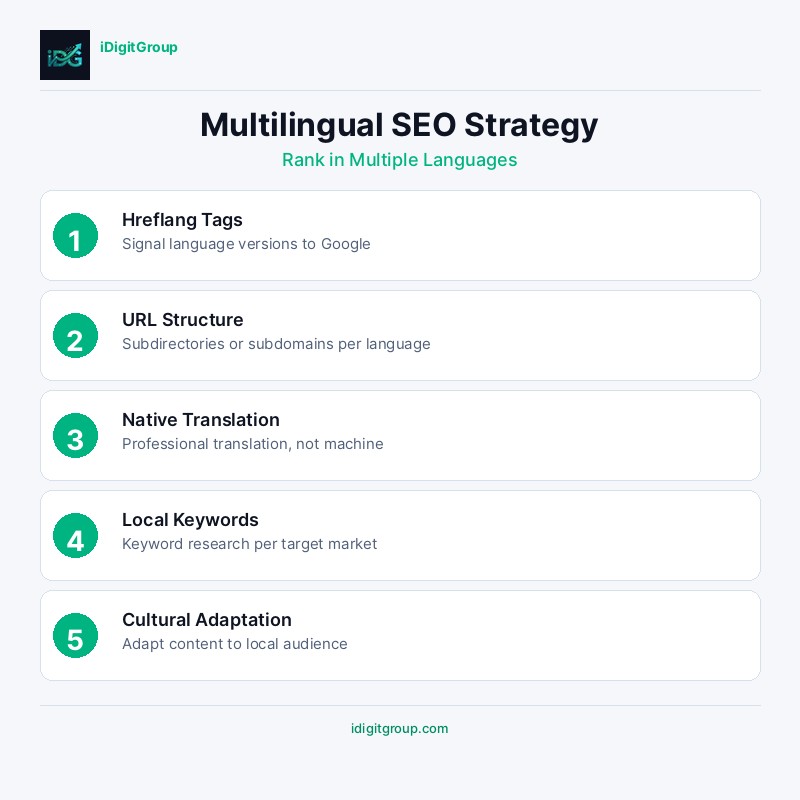
A multilingual SEO strategy is the combination of technical implementation, content localisation, and off-page authority building that makes a website discoverable and rankable by search engines in more than one language or country: not simply a translated version of your existing site. The technical core is hreflang tagging, which tells search engines which language and regional version of a page to show which users, paired with a clear URL structure (subdirectories, subdomains, or country-code domains) that avoids duplicate content penalties. Layered on top of that, genuine localisation means adapting content, keywords, currency, and cultural references to how people in each target market actually search, rather than assuming a direct translation will resonate. Businesses that invest properly in multilingual SEO typically see 47% higher organic traffic growth compared to those relying on translation alone, because search behaviour genuinely differs by market, Google dominates in the West, but Baidu leads in China, Yandex in Russia, and Naver in South Korea, and even within Google, Spanish searchers in Spain behave differently from those in Mexico or Argentina. Get the strategy wrong and you risk duplicate content issues, poor user experience, and wasted investment. This guide covers the essential components of building a robust multilingual SEO strategy for 2026.
Why You Need a Multilingual SEO Strategy
Expanding into international markets represents one of the most significant growth opportunities for businesses in 2026. However, simply translating your website content is not enough to capture organic traffic in new languages and regions. A proper multilingual SEO strategy requires understanding how search behaviour differs across cultures, implementing the correct technical infrastructure, and creating content that resonates with local audiences. Businesses that invest in multilingual SEO typically see 47% higher organic traffic growth compared to those relying on translation alone.
The global search landscape is increasingly diverse. While Google dominates in most Western markets, Baidu leads in China, Yandex in Russia, and Naver in South Korea. Even within Google, search behaviour varies dramatically between languages. Spanish speakers in Spain search differently from those in Mexico or Argentina, and Italian searchers have distinct preferences compared to their English-speaking counterparts.
A dedicated strategy is crucial for several reasons:
- Avoiding Duplicate Content: Simply translating content without the proper technical signals can cause search engines to see your different language versions as duplicate content, harming your rankings.
- Targeting the Right Audience: Different regions have different search behaviours, keywords, and cultural nuances. A one-size-fits-all approach will not be effective.
- Improving User Experience: Providing content in a user's native language, with localised currency, date formats, and cultural references, significantly improves user experience and conversion rates.
- Gaining a Competitive Advantage: Many businesses neglect proper international SEO, creating a significant opportunity for those who get it right.
Key Components of a Multilingual SEO Strategy
Building a successful strategy involves three main pillars: technical SEO, content localisation, and off-page authority building.
1. Technical SEO for International Websites
The technical foundation of a multilingual website determines whether search engines can properly discover, crawl, and index your content in each language. The three main URL structure options are subdirectories (example.com/it/), subdomains (it.example.com), and country-code top-level domains (example.it). Subdirectories are generally recommended as they consolidate domain authority and are the easiest to manage.
Hreflang tags are essential for telling search engines which language version of a page to show to users in different regions. Each page must include hreflang annotations pointing to all language versions, including a self-referencing tag. Common hreflang implementation errors include missing self-referencing tags, inconsistent URL formats, and failing to include an x-default tag for users whose language is not specifically targeted.
2. Content Localisation Beyond Translation
Effective multilingual SEO goes beyond word-for-word translation. Content must be localised to reflect local search intent, cultural references, and regional terminology. Keyword research must be conducted independently for each target language, as direct translations of English keywords rarely match actual search behaviour. For example, the English term "estate agent" translates differently across Spanish-speaking countries, and the search volume for equivalent terms varies significantly.
3. Local Link Building and Authority
Building authority in each target market requires a dedicated link building strategy. This includes securing links from local industry publications, directories, and news sites in each language. Guest posting on local blogs, participating in regional industry events, and building relationships with local influencers all contribute to establishing domain authority in new markets.
Common Multilingual SEO Mistakes
Several common mistakes can undermine your multilingual SEO efforts. Using automatic translation without human review produces content that reads unnaturally and fails to capture local search intent. Implementing hreflang tags incorrectly causes search engines to show the wrong language version to users. Duplicating content across language versions without proper canonicalisation creates duplicate content issues. Neglecting to build local backlinks in each target market limits your authority in those regions.
Another critical mistake is assuming that keyword research in one language translates directly to another. Search volumes, competition levels, and user intent can vary dramatically between languages. Always conduct independent keyword research for each target market and adapt your content strategy accordingly.
Measuring Multilingual SEO Success
Track performance for each language version separately using Google Search Console's country and language filters. Key metrics include organic traffic by language, keyword rankings in each target market, conversion rates by language, and crawl coverage for each language version. Set realistic timelines: multilingual SEO typically takes 6-12 months to show significant results in new markets.
The technical foundation is critical for signaling your site's language and country targeting to search engines.
URL Structure
You have three main options for structuring your international URLs. Each has its pros and cons.
| URL Structure | Pros | Cons |
|---|---|---|
| ccTLDs (Country-Code Top-Level Domains) e.g., example.de | Strongest geotargeting signal; clear to users. | Expensive; requires managing multiple domains. |
| Subdomains e.g., de.example.com | Easy to set up; allows different server locations. | Weaker geotargeting signal than ccTLDs. |
| Subdirectories (Subfolders) e.g., example.com/de/ | Easiest to manage; consolidates domain authority. | Weaker geotargeting signal; single server location. |
Hreflang Tags
hreflang is an HTML attribute that tells Google which language and regional version of a page to show to a user. It is the most important technical element for preventing duplicate content issues.
An hreflang tag looks like this:
This tells Google that the German version of the page for users in Germany is at the specified URL.
Best Practices for hreflang:
- Self-Referencing: Each page must have a self-referencing
hreflangtag. - Reciprocal: If page A links to page B, page B must link back to page A.
- Include
x-default: Use anx-defaulttag to specify the fallback page for users whose language/region does not match any of your specified versions.
2. Content Localisation, Not Just Translation
Direct translation is not enough. True localisation involves adapting your content to the cultural and linguistic nuances of your target market.
- Keyword Research: Do not simply translate your English keywords. Perform native keyword research in each target language to understand how users search in that market.
- Cultural Nuances: Adapt your messaging, imagery, and calls-to-action to be culturally appropriate.
- Formats: Localise currency, date formats, units of measurement, and contact information.
3. International Link Building
To build authority in a new market, you need to acquire backlinks from relevant, high-authority websites in that region. A backlink from a popular German blog is far more valuable for your German site than a link from a US-based site.
- Local Directories: Get listed in reputable local business directories.
- Regional Publications: Reach out to bloggers and journalists in your target country.
- Competitor Analysis: Analyse the backlink profiles of your local competitors to find link-building opportunities.
Measuring International SEO Success
To track your performance, you need to segment your data by country and language.
- Google Search Console: Set up separate properties for each subdirectory or subdomain to get granular data on queries, clicks, and impressions for each market.
- Google Analytics: Use advanced segments or views to analyse user behaviour, conversions, and engagement by country.
Frequently Asked Questions (FAQ)
Q: Should I use a machine translation tool like Google Translate? A: No. While machine translation has improved, it cannot capture the nuances of language and culture. It often results in awkward phrasing and a poor user experience. Always use professional human translators.
Q: What is the difference between language targeting and country targeting?
A: Language targeting (e.g., en) targets users who speak a certain language, regardless of their location. Country targeting (e.g., en-GB) targets users in a specific country. Be as specific as possible.
Q: Do I need a local server for each country? A: While a local server can improve page speed, it is not essential, especially if you use a Content Delivery Network (CDN). A CDN can serve your content from a server close to the user, regardless of your main server's location.