
Why Content Marketing Is Essential for Small Businesses
Content marketing is frequently oversold as a magic solution and undersold as a long-term commitment. The reality is somewhere in between: done consistently and strategically, it is one of the few marketing channels where the assets you create this year will still be generating traffic and leads in five years. Done inconsistently or without a clear audience in mind, it produces a blog that nobody reads and a lot of wasted effort. This guide is for small businesses that want to build the real version: a content operation with clear goals, a realistic publishing rhythm, and a way to measure whether it's working.
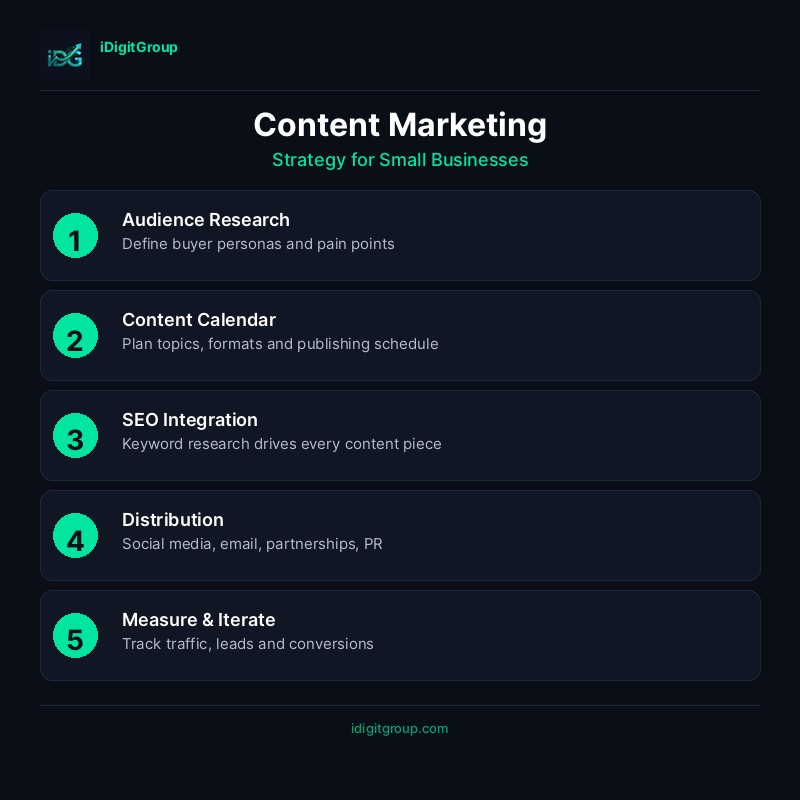
The challenge for most small businesses is not understanding the value of content marketing, it is knowing where to start, what to create, and how to measure success. This guide provides a practical, actionable framework for building a content marketing strategy that delivers real business results, regardless of your budget or team size.
"Content marketing costs 62% less than traditional marketing and generates approximately three times as many leads.", Demand Metric
Defining Your Content Marketing Goals
Before creating a single piece of content, you must define what success looks like for your business. Vague goals like "get more traffic" lead to unfocused content that fails to deliver measurable results.
Aligning Content Goals with Business Objectives
| Business Objective | Content Goal | Content Type |
|---|---|---|
| Increase brand awareness | Grow organic traffic | Blog posts, guides, infographics |
| Generate leads | Capture email addresses | Gated content, webinars, checklists |
| Establish authority | Build thought leadership | Research reports, expert guides |
| Support sales | Educate prospects | Case studies, comparison pages |
| Improve retention | Reduce churn | Tutorials, knowledge base articles |
Understanding Your Audience
Effective content marketing begins with a deep understanding of who you are creating content for. Generic content that tries to appeal to everyone appeals to no one.
Building Audience Personas
Create detailed personas for your primary audience segments. Each persona should include demographic information, professional challenges, content consumption habits, and the questions they ask at each stage of the buying journey.
Mapping the Customer Journey
Content should address every stage of the customer journey, from initial awareness through to purchase decision and post-purchase support.
| Stage | Customer Mindset | Content Format |
|---|---|---|
| Awareness | "I have a problem" | Blog posts, social media, videos |
| Consideration | "What are my options?" | Comparison guides, case studies |
| Decision | "Which solution is best?" | Testimonials, demos, pricing pages |
| Retention | "How do I get the most from this?" | Tutorials, newsletters, community |
Keyword Research and Topic Planning
Keyword research is the bridge between what your audience is searching for and the content you create. A systematic approach to topic planning ensures every piece of content targets genuine search demand.
Finding Content Opportunities
Start by identifying the questions your customers ask most frequently. Sales teams, customer support logs, and social media comments are goldmines for content ideas. Then validate these topics with keyword research to confirm search volume and assess competition.
Focus on long-tail keywords with clear intent. A small business is unlikely to rank for "marketing" but can absolutely rank for "content marketing strategy for independent restaurants" or "how to create a blog for a plumbing business."
Creating a Content Calendar
A content calendar transforms ad-hoc publishing into a strategic programme. Plan content at least three months in advance, balancing different content types, topics, and stages of the customer journey.
Your calendar should include:
- Publication dates and deadlines
- Target keywords for each piece
- Content format and word count
- Internal linking targets
- Distribution channels
- Responsible team member
Creating Content That Ranks and Converts
The quality bar for content has never been higher. Search engines and readers alike reward comprehensive, well-researched content that genuinely helps the reader.
Writing for Search Engines and Humans
The best content satisfies both search engine algorithms and human readers. This means structuring content with clear headings (H2, H3, H4), including relevant keywords naturally, and providing genuine value that answers the searcher's query completely.
Content Structure Best Practices
Every piece of content should follow a proven structure:
- Compelling introduction that hooks the reader and establishes relevance
- Clear heading hierarchy that allows scanning and improves accessibility
- Substantive body content with data, examples, and actionable advice
- Visual elements including tables, lists, and images to break up text
- Strong conclusion with a clear next step or call to action
Content Length and Depth
Research consistently shows that longer, more comprehensive content outperforms thin content in search rankings. However, length alone is not the goal, depth and quality are what matter. A 2,000-word article that thoroughly covers a topic will outrank a 5,000-word article padded with fluff.
| Content Type | Recommended Length | Purpose |
|---|---|---|
| Blog post | 1,500 to 2,500 words | Organic traffic, authority |
| Pillar page | 3,000 to 5,000 words | Topical authority, link magnet |
| How-to guide | 2,000 to 3,000 words | Problem-solving, featured snippets |
| Case study | 1,000 to 1,500 words | Social proof, decision support |
| FAQ page | 1,500 to 2,000 words | Long-tail keywords, voice search |
Content Distribution and Promotion
Creating great content is only half the battle. Without a distribution strategy, even the best content will fail to reach its intended audience.
Organic Distribution Channels
- Search engine optimisation: Ensure every piece is optimised for target keywords
- Email marketing: Share new content with your subscriber list
- Social media: Adapt content for each platform's format and audience
- Industry forums: Share expertise in relevant communities
- Guest posting: Contribute to authoritative sites in your industry
Building an Email List
An email list is the most valuable owned media asset a small business can build. Unlike social media followers, email subscribers are yours, no algorithm changes can take them away. Offer genuine value in exchange for email addresses: checklists, templates, exclusive guides, or industry reports.
Repurposing Content
Small businesses with limited resources should maximise the value of every piece of content by repurposing it across formats. A comprehensive blog post can become a series of social media posts, an infographic, a podcast episode, a video script, and a newsletter feature.
Internal Linking for Content Authority
Internal linking is one of the most powerful yet underutilised content marketing tactics. Strategic internal links distribute authority throughout your site, help search engines understand your content hierarchy, and guide readers to related content.
Building Topic Clusters
Organise your content into topic clusters: a comprehensive pillar page supported by multiple related articles that link back to it. This structure signals topical authority to search engines and creates a logical navigation path for readers.
For example, a pillar page on "Local SEO" might link to supporting articles on Google Business Profile optimisation, local ranking factors, and citation building.
Link Placement Best Practices
Place internal links within the body content where they add genuine value to the reader. Avoid clustering links at the end of articles or using generic anchor text. Each internal link should use descriptive, keyword-relevant anchor text that accurately describes the target page.
Measuring Content Marketing ROI
Measuring the return on investment of content marketing requires tracking both leading indicators (traffic, engagement) and lagging indicators (leads, revenue).
Key Metrics to Track
| Metric | What It Measures | Tool |
|---|---|---|
| Organic traffic | Search visibility | Google Analytics |
| Keyword rankings | SERP positions | Search Console, Ahrefs |
| Time on page | Content engagement | Google Analytics |
| Bounce rate | Content relevance | Google Analytics |
| Conversion rate | Lead generation | Google Analytics |
| Backlinks earned | Content authority | Ahrefs, Moz |
| Email subscribers | Audience growth | Email platform |
Attribution and Revenue Tracking
For small businesses, the most important metric is ultimately revenue generated from content marketing efforts. Set up goal tracking in Google Analytics to attribute conversions to specific content pieces. Track the full journey from first organic visit to purchase to understand which content drives the most valuable customers.
Content Marketing on a Limited Budget
Small businesses do not need large budgets to succeed with content marketing. What they need is consistency, focus, and a willingness to invest time in creating genuinely valuable content.
Prioritising High-Impact Content
If you can only publish two pieces of content per month, make them count. Focus on comprehensive, evergreen content that targets keywords with consistent search volume. A single 2,000-word guide that ranks for dozens of long-tail keywords is more valuable than ten 300-word posts that rank for nothing.
Leveraging Free Tools
Numerous free tools can support your content marketing efforts: Google Search Console for keyword data, Google Analytics for traffic analysis, AnswerThePublic for content ideas, and Canva for basic graphic design. You do not need expensive enterprise tools to build an effective content strategy.
Frequently Asked Questions
How often should a small business publish content?
Consistency matters more than frequency. Publishing one high-quality article per week is more effective than publishing daily low-quality content. Start with a sustainable cadence, even twice per month, and increase frequency as you build capacity and see results.
What type of content works best for small businesses?
How-to guides, local area content, and industry-specific advice tend to perform best for small businesses. These formats target long-tail keywords with less competition and directly address the questions your potential customers are asking.
How long before content marketing delivers results?
Content marketing typically takes three to six months to show measurable results in organic traffic. However, the compounding nature of content means that results accelerate over time. Content published today will continue generating traffic and leads for years.
Should I hire a content writer or write content myself?
If you have subject matter expertise, writing your own content ensures authenticity and authority. However, if writing is not your strength or you lack time, hiring a professional writer who understands SEO is a worthwhile investment. The key is ensuring the content reflects genuine expertise.
How do I know which topics to write about?
Start with the questions your customers ask most frequently. Use keyword research tools to validate search demand, then prioritise topics where you can provide genuine expertise and where competition is manageable. Your SEO optimisation strategy should guide topic selection.
Conclusion
Content marketing is not a quick fix, it is a long-term investment that builds sustainable competitive advantage. For small businesses willing to commit to consistent, high-quality content creation, the rewards are substantial: increased organic traffic, stronger brand authority, higher-quality leads, and a growing library of assets that work for you around the clock.
Start with a clear strategy, focus on your audience's genuine needs, and measure everything. Over time, your content will become one of your most valuable business assets. Contact us to discuss how we can help you build a content marketing strategy that drives real growth.