
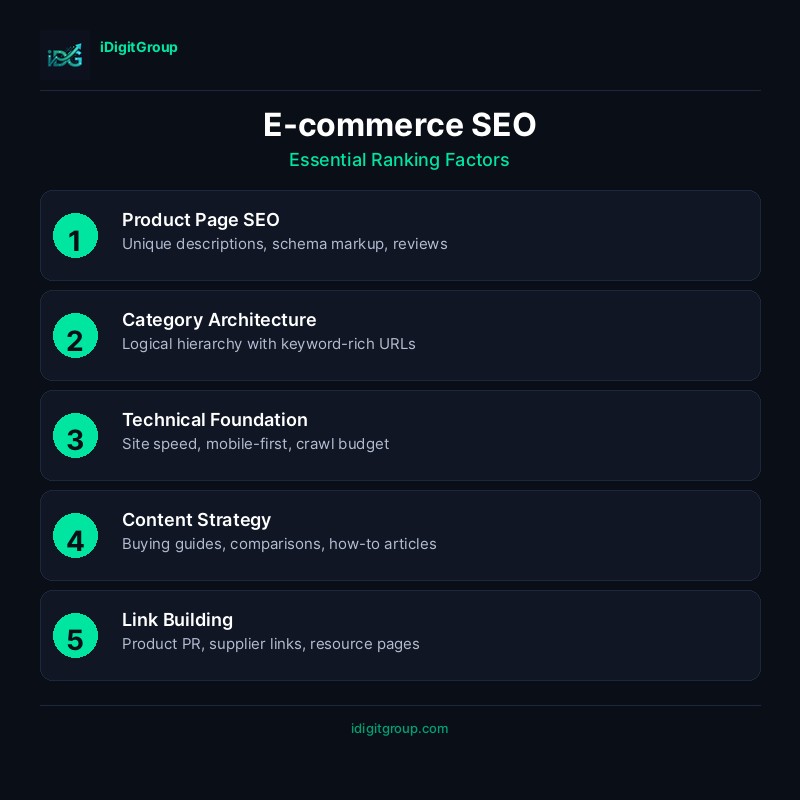
Why E-commerce SEO Matters More Than Ever
E-commerce SEO is the practice of optimising an online store's site architecture, product and category pages, technical performance, and content so it ranks organically for the searches shoppers actually use: and it matters because organic search drives over 40% of all e-commerce revenue, making it the single most important long-term growth channel for online retailers. Unlike paid campaigns, where traffic stops the moment you pause your budget, organic rankings compound over time: a well-optimised product page can keep generating sales for years without additional spend, which is what makes SEO a fundamentally different kind of investment from advertising. In a fiercely competitive e-commerce landscape where millions of stores compete for the same shoppers, relying solely on paid advertising is neither sustainable nor cost-effective. As BrightEdge Research notes, "Organic search accounts for 53% of all website traffic globally, and for e-commerce sites, it's the highest-converting traffic source after direct visits." This guide covers every aspect of e-commerce SEO, from technical foundations to advanced content strategies.
"Organic search accounts for 53% of all website traffic globally, and for e-commerce sites, it's the highest-converting traffic source after direct visits.", BrightEdge Research
Site Architecture and URL Structure
The foundation of e-commerce SEO begins with how your website is structured. Search engines need to crawl and understand your product catalogue efficiently, and users need to navigate it intuitively.
Creating a Logical Category Hierarchy
Your category structure should mirror how customers think about your products. A flat hierarchy with no more than three clicks from the homepage to any product page is ideal. Consider this structure:
| Level | Example | URL Pattern |
|---|---|---|
| Homepage | Store | / |
| Category | Men's Clothing | /mens-clothing/ |
| Subcategory | Jackets | /mens-clothing/jackets/ |
| Product | Leather Bomber Jacket | /mens-clothing/jackets/leather-bomber/ |
URL Best Practices for E-commerce
Clean, descriptive URLs significantly impact both rankings and click-through rates. Every product URL should be readable, keyword-rich, and consistent. Avoid session IDs, unnecessary parameters, and overly long strings. Use hyphens to separate words and keep URLs lowercase.
Your SEO strategy should include a thorough URL audit to identify and resolve any structural issues before they compound.
Product Page Optimisation
Product pages are the revenue-generating heart of any e-commerce site. Each page must be optimised for both search engines and conversions.
Title Tags and Meta Descriptions
Every product page needs a unique, keyword-rich title tag following this formula: Primary Keyword + Brand/Product Name + Modifier. For example, "Organic Cotton T-Shirt | EcoWear | Free UK Delivery" is far more effective than a generic "Product Page."
Meta descriptions should include the primary keyword, a compelling benefit, and a clear call to action. Keep them under 155 characters to avoid truncation in search results.
Product Descriptions That Rank and Convert
Thin product descriptions are one of the most common e-commerce SEO failures. Each product page should have a minimum of 300 words of unique, descriptive content. Avoid copying manufacturer descriptions, duplicate content across thousands of retailer sites will never rank.
Structure your product descriptions with:
- A compelling opening paragraph addressing the customer's need
- Key features presented in scannable bullet points
- Detailed specifications in a structured table
- Social proof elements such as review counts or ratings
- A clear call to action
Schema Markup for Products
Implementing structured data on product pages enables rich snippets in search results, displaying price, availability, and ratings directly in the SERP. This dramatically increases click-through rates.
| Schema Type | Purpose | Impact |
|---|---|---|
| Product | Price, availability, brand | Rich product snippets |
| AggregateRating | Star ratings | Social proof in SERPs |
| Review | Individual reviews | Enhanced trust signals |
| Offer | Pricing, currency | Price display in results |
| BreadcrumbList | Navigation path | Sitelinks in results |
Technical SEO for E-commerce Sites
E-commerce sites face unique technical challenges due to their size and complexity. Addressing these issues is critical for maintaining crawl efficiency and rankings.
Crawl Budget Management
Large e-commerce sites with thousands of products must manage their crawl budget carefully. Search engines allocate a finite number of pages to crawl per session. Wasting this budget on filtered URLs, pagination variants, or out-of-stock pages means your most important pages may not get crawled frequently enough.
Use robots.txt and canonical tags strategically. Block faceted navigation parameters that create duplicate content, but ensure all genuine product and category pages remain accessible.
Page Speed and Core Web Vitals
Site speed is a confirmed ranking factor, and for e-commerce sites, it directly impacts revenue. Research shows that a one-second delay in page load time can reduce conversions by 7%. Optimising your Core Web Vitals should be a top priority.
Key speed optimisations for e-commerce include:
- Compressing and lazy-loading product images
- Implementing a Content Delivery Network (CDN)
- Minimising JavaScript and CSS bundles
- Using next-generation image formats like WebP
- Enabling browser caching for static assets
Handling Out-of-Stock Products
How you handle discontinued or out-of-stock products has significant SEO implications. Never simply delete product pages that have accumulated backlinks and rankings. Instead, consider these approaches:
| Scenario | Recommended Action |
|---|---|
| Temporarily out of stock | Keep page live, show "out of stock" status |
| Permanently discontinued | 301 redirect to closest alternative product |
| Seasonal product | Keep page live year-round, update availability |
| Entire category removed | 301 redirect to parent category |
Content Strategy for E-commerce
Beyond product pages, a robust content strategy helps e-commerce sites capture top-of-funnel traffic and build topical authority.
Buying Guides and Comparison Content
Creating comprehensive buying guides positions your store as an authority and captures informational search queries. A guide titled "How to Choose the Right Running Shoes" can rank for dozens of long-tail keywords and funnel readers toward your product pages.
Blog Content That Drives Sales
An e-commerce blog should serve two purposes: attracting organic traffic and guiding visitors toward purchase decisions. Topics should align with your product categories and address genuine customer questions.
Effective e-commerce blog content includes:
- Product comparison articles
- How-to guides related to your products
- Industry trend analysis
- Customer success stories and use cases
- Seasonal buying guides
User-Generated Content
Customer reviews, Q&A sections, and user photos provide fresh, unique content that search engines value. Encourage customers to leave detailed reviews and implement a Q&A feature on product pages. This content naturally includes long-tail keywords that your copywriters might never think to target.
Internal Linking Strategy
Internal linking is arguably the most underutilised SEO tactic in e-commerce. A strategic internal linking structure distributes page authority throughout your site and helps search engines understand the relationship between your pages.
Breadcrumb Navigation
Breadcrumbs serve dual purposes: they improve user navigation and provide search engines with a clear understanding of your site hierarchy. Implement breadcrumb schema markup to display the navigation path in search results.
Cross-Selling and Related Products
"Customers also bought" and "Related products" sections are not just conversion tools, they create valuable internal links between product pages. Ensure these sections use descriptive anchor text rather than generic "View product" links.
Category Page Optimisation
Category pages are often the highest-ranking pages on e-commerce sites. Treat them as landing pages with unique introductory content, featured products, and links to relevant subcategories and buying guides.
International E-commerce SEO
For stores selling across borders, international SEO requires careful planning. Implementing hreflang tags correctly, managing currency and language variations, and building country-specific backlinks are all essential. Our guide on building a multilingual SEO strategy covers the technical implementation in detail.
| Element | Implementation |
|---|---|
| Hreflang tags | One per language/region combination |
| Currency display | Localised to user's region |
| Content translation | Professional, not machine-translated |
| Local backlinks | Country-specific link building |
| Server location | CDN with regional edge servers |
Measuring E-commerce SEO Success
Tracking the right metrics ensures your SEO efforts translate into revenue. Focus on these key performance indicators:
Revenue-Focused Metrics
- Organic revenue: Total sales from organic search traffic
- Organic conversion rate: Percentage of organic visitors who purchase
- Average order value from organic: Compared to other channels
- Customer lifetime value from organic: Long-term value of SEO-acquired customers
Visibility Metrics
- Keyword rankings: Track positions for product and category keywords
- Organic traffic growth: Month-over-month and year-over-year trends
- Indexed pages: Ensure all important pages are in Google's index
- Click-through rate: Optimise titles and descriptions for higher CTR
Frequently Asked Questions
How long does e-commerce SEO take to show results?
E-commerce SEO typically takes three to six months to show meaningful results for competitive keywords. However, quick wins such as fixing technical issues, optimising title tags, and improving site speed can deliver improvements within weeks. Long-tail product keywords often rank faster than competitive category terms.
Should I use a subdomain or subdirectory for my blog?
Always use a subdirectory (yourstore.com/blog/) rather than a subdomain (blog.yourstore.com). Subdirectories consolidate domain authority, meaning your blog content directly strengthens the rankings of your product and category pages.
How do I handle duplicate content from product variations?
Use canonical tags to point all colour, size, and style variations to the primary product page. If variations have significantly different content (such as different descriptions for different colours), consider keeping them as separate pages with unique content.
Is it worth optimising out-of-stock product pages?
Yes, if those pages have existing rankings and backlinks. Redirect permanently discontinued products to the closest alternative. For temporarily out-of-stock items, keep the page live and clearly indicate when the product will be available again.
How many products should a category page display?
Display enough products to provide a good user experience without sacrificing page speed. Typically, 20 to 40 products per page with lazy-loading pagination works well. Ensure the category page includes at least 150 words of unique introductory content above the product grid.
Conclusion
E-commerce SEO is a multifaceted discipline that requires attention to technical foundations, content quality, and user experience simultaneously. By implementing the strategies outlined in this guide, from optimising your site architecture and product pages to building a comprehensive content strategy, you can create a sustainable source of organic traffic and revenue that grows over time.
The most successful e-commerce businesses treat SEO not as a one-time project but as an ongoing investment. Regular technical audits, continuous content creation, and strategic link building will compound your results and create a competitive advantage that paid advertising alone cannot match. Get in touch to discuss how we can help your e-commerce business grow through organic search.