
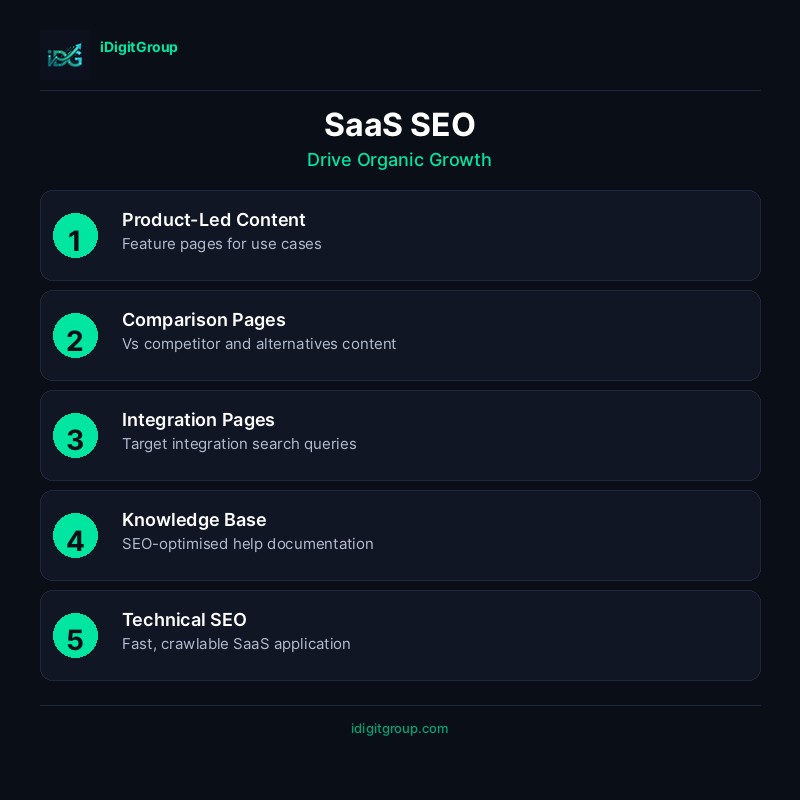
Search Engine Optimisation (SEO) for Software-as-a-Service (SaaS) companies is a unique discipline. Unlike e-commerce or local businesses, the SaaS sales cycle is often longer, the product is intangible, and the customer journey involves multiple touchpoints, from initial awareness to free trial and eventual conversion. A robust SaaS SEO strategy is the engine that drives sustainable, long-term organic growth.
This guide provides a comprehensive framework for building and executing a SaaS SEO strategy that attracts, engages, and converts high-value customers in 2026.
The SaaS SEO Funnel
SaaS SEO differs fundamentally from traditional SEO because the customer journey is longer, more complex, and involves multiple touchpoints before conversion. The SaaS SEO funnel maps content to each stage of the buyer's journey: awareness (problem identification), consideration (solution evaluation), decision (product comparison), and retention (customer success). At the top of the funnel, educational content captures users searching for solutions to their problems. In the middle, comparison guides and feature-focused content help prospects evaluate options. At the bottom, case studies, pricing pages, and free trial landing pages drive conversions. The most successful SaaS companies create content for every stage, building a comprehensive organic acquisition engine that compounds over time.
A successful strategy aligns content with the user's journey through the marketing funnel. This is often broken down into three stages:
- Top of Funnel (ToFu): Attracting a broad audience who are problem-aware but not yet solution-aware. Content at this stage is educational and informational.
- Middle of Funnel (MoFu): Engaging users who are actively researching solutions. This content compares alternatives and showcases your product's value.
- Bottom of Funnel (BoFu): Converting users who are ready to make a decision. This content focuses on your product's features, pricing, and competitive advantages.
Key Pillars of a SaaS SEO Strategy
An effective strategy is built on four key pillars: content marketing, technical SEO, link building, and user experience.
1. Content Marketing: The Engine of SaaS SEO
Content marketing is the primary growth driver for SaaS SEO, but the approach must be strategic rather than volume-based. Start by mapping your product's features to the problems your target customers search for. Create detailed, authoritative guides that position your product as the solution without being overtly promotional. The most effective SaaS content types include problem-solution articles ("How to [solve problem]"), comparison posts ("[Your Product] vs [Competitor]"), use case guides ("How [Industry] Teams Use [Product]"), and data-driven research that establishes thought leadership.
Programmatic SEO is particularly powerful for SaaS companies with large datasets. Create template-based pages targeting long-tail keywords at scale: for example, "[Integration] + [Your Product]" pages, "[Use Case] templates", or "[Industry] benchmarks". These pages can capture thousands of long-tail searches that individually have low volume but collectively drive significant traffic.
2. Technical SEO for SaaS Websites
SaaS websites present unique technical SEO challenges, including JavaScript-heavy rendering, dynamic content, authenticated areas, and complex URL structures. Ensure your marketing pages are server-side rendered or statically generated for optimal crawlability. Implement proper canonical tags to prevent duplicate content issues between marketing pages and app pages. Use robots.txt and noindex tags to keep authenticated dashboard pages out of search indexes. Monitor Core Web Vitals closely, as SaaS websites often suffer from slow loading times due to heavy JavaScript bundles.
Measuring SaaS SEO Success
Track SaaS-specific SEO metrics beyond traditional rankings and traffic. Key metrics include organic signups, free trial conversions from organic traffic, content-assisted conversions (where a user visited a blog post before converting), and customer acquisition cost (CAC) from organic channels. Compare organic CAC against paid channels to demonstrate SEO's ROI to stakeholders. Most SaaS companies see meaningful organic results within 6-12 months, with compounding returns as content authority builds over time.
Content is at the heart of any SaaS SEO strategy. Your goal is to create a content ecosystem that addresses user needs at every stage of the funnel.
Top of Funnel (ToFu) Content
- Blog Posts: Create in-depth articles that solve your target audience's problems. Target informational keywords with high search volume.
- Free Tools: Develop simple, free tools that provide value and introduce users to your brand. For example, a social media scheduling tool could offer a free hashtag generator.
- Glossaries and "What is..." Pages: Define key industry terms to capture educational search traffic.
Middle of Funnel (MoFu) Content
- Comparison Pages: Create detailed comparisons between your product and your competitors (e.g., "[Your Product] vs. [Competitor]").
- "Alternatives to..." Pages: Target users who are specifically looking for alternatives to a competitor's product.
- Case Studies: Showcase how your existing customers have found success with your product.
Bottom of Funnel (BoFu) Content
- Features Pages: Create dedicated pages for each of your key features, optimising for feature-specific keywords.
- Pricing Page: A clear, transparent pricing page is essential for conversion.
- Use Case Pages: Show how your product can be used to solve specific problems for different user personas or industries.
2. Technical SEO for SaaS Websites
A solid technical foundation ensures that search engines can efficiently crawl, index, and understand your content.
- Site Speed: A fast-loading website is crucial for user experience and rankings. Compress images, leverage browser caching, and use a Content Delivery Network (CDN).
- Mobile-Friendliness: Your website must be fully responsive and provide a seamless experience on all devices.
- Structured Data: Use schema markup to provide context to search engines. Key types for SaaS include
SoftwareApplication,FAQPage, andVideoObject.
3. Link Building for Authority
Backlinks from reputable websites are a powerful signal of authority to search engines. For SaaS, quality is more important than quantity.
- Digital PR: Create data-driven studies, surveys, and reports that journalists and bloggers will want to cite and link to.
- Guest Posting: Write for authoritative publications in your industry to build your brand and acquire high-quality backlinks.
- Podcast Tours: Appearing as a guest on relevant podcasts can drive brand awareness and generate links from the podcast's website.
4. User Experience and Conversion Rate Optimisation (CRO)
Getting users to your site is only half the battle. You need to convert them into paying customers.
- Clear Calls-to-Action (CTAs): Every page should have a clear, compelling CTA, whether it's "Start Free Trial," "Request a Demo," or "Learn More."
- Social Proof: Display customer testimonials, reviews, and logos of well-known clients to build trust.
- Frictionless Onboarding: Make your free trial sign-up and onboarding process as simple and intuitive as possible.
Measuring SaaS SEO Success
Beyond organic traffic, you need to track metrics that tie directly to business growth.
| Metric | What it Measures | Why it Matters for SaaS |
|---|---|---|
| Organic Traffic | The number of visitors from search engines. | Top-level indicator of visibility. |
| Keyword Rankings | Your position in the SERPs for target keywords. | Tracks progress for specific topics. |
| Free Trial Sign-ups | The number of users who sign up for a free trial. | Measures MoFu/BoFu content effectiveness. |
| Lead-to-Customer Rate | The percentage of trial users who become paying customers. | The ultimate measure of SEO ROI. |
Frequently Asked Questions (FAQ)
Q: How long does it take for SaaS SEO to work? A: SEO is a long-term investment. It typically takes 6-12 months of consistent effort to see significant results. However, the organic growth it drives is sustainable and highly cost-effective over time.
Q: Should I focus on high-volume or high-intent keywords? A: You need a balance of both. High-volume ToFu keywords build brand awareness, while high-intent BoFu keywords drive conversions. A comprehensive strategy targets the full funnel.
Q: Is link building still important for SaaS? A: Yes. High-quality backlinks from authoritative sites are one of the strongest ranking factors and are essential for building trust and credibility in a competitive market.